
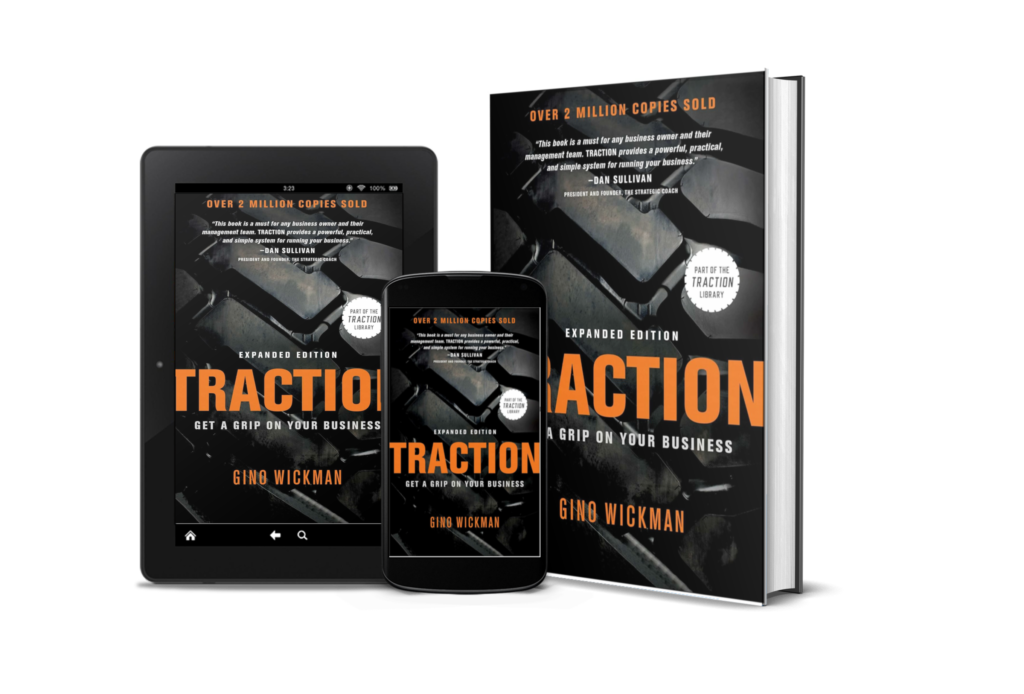
Disclaimer: “This review aims to educate aspiring Business Leaders. Be aware that links to purchase books are affiliate links. Your small support via these links helps fund further deep dives into Best Business Books.”
The “Traction” 10 Key Lessons, Summary, Main Idea, and Story, About the Author: Gino Wickman, Key Takeaways, Video, Pros and Cons, and FAQs
4.6 ⭐⭐⭐⭐⭐ out of 5 stars (9,263)
👉 See why 9,263+ readers love this book
Introduction
Do you feel like you’re running your business, or is your business running you? Many entrepreneurs hit a wall, buried in daily chaos, unable to scale their vision. That wall is usually caused by a lack of system and discipline. That is exactly what Gino Wickman addresses in his revolutionary book, Traction: Get a Grip on Your Business.
This book introduces the Entrepreneurial Operating System (EOS), a practical, proven framework designed to solve the five core problems that plague every business. Wickman argues that genius ideas aren’t enough; you need a system to execute them, and this book gives you the blueprint.
In this comprehensive Traction Book Summary, you will discover the following:
- The EOS System: The six essential components you must master to gain control.
- The Accountability Chart: How to get the right people in the right seats. (To improve personal discipline which is crucial for leadership, read our review of Atomic Habits Book ).
- Vision & Culture: Defining where you’re going and how you’ll get there.
- The 10 Key Lessons: A step-by-step plan to implement EOS today.
- Cash Flow & Profit: Systems to manage the financial side effectively. (For personal financial principles that apply to small businesses, check out The Psychology of Money Book ).
- Pros and Cons: An honest assessment of the EOS model.
- FAQs: Clear answers to common questions about implementing EOS.
If you’re ready to get out of the weeds and take your company to the next level, the system starts here.
For Leadership and Discipline (Extended Analysis):
If you are ready to implement the discipline needed for the EOS system, find a different, extended analysis of this highly related book on our partner site:
The “Extreme Ownership” 10 Key Lessons, summary, and Main Idea
About the Author: Ramit Sethi, Key Takeaways, video, Pros and Con and FAQs
🎯 Main Idea and Summary: An Operating System for Your Business
Main Idea
The central idea of “Traction” is that for a business to succeed, all of its key components must be strengthened and aligned. Wickman introduces the Entrepreneurial Operating System (EOS), a framework built on Six Key Components™: Vision, People, Data, Issues, Process, and Traction. The book argues that by systematically strengthening these components using simple tools, leadership teams can gain control, eliminate chaos, and achieve their vision.
Summary
Gino Wickman’s “Traction” is a practical field guide, not a theoretical textbook. It provides a step-by-step method for implementing EOS, which is designed specifically for entrepreneurial companies. The book is structured around the six components, introducing a set of powerful tools for each:
- The Vision/Traction Organizer (V/TO) to get the leadership team 100% on the same page.
- The Accountability Chart to create a clear, function-based organizational structure.
- Rocks to set and achieve quarterly priorities.
- The Level 10 Meeting™ to run highly effective weekly meetings.
- The Scorecard to monitor weekly metrics.
Wickman’s approach is direct and prescriptive, offering a clear path out of the day-to-day frustrations that plague most business owners.
The Cartographer’s Ink (Story)
Eliza worked in the dusty silence of the archival basement, a place where time was measured not in minutes, but in the brittle decay of paper and the faint, sweet smell of aged glue. She was an archivist—a curator of the past—and today, her hands were occupied with the personal effects of Elias Thorne, a forgotten cartographer from the 1920s.
Thorne had died childless, his estate reduced to a dozen boxes of unremarkable maps and surveying tools. Eliza expected charts of state lines and property claims. Instead, she found the final box contained only one item: a leather-bound journal, its cover stamped with the faded outline of a compass rose.
She handled it with the reverence due to objects that had absorbed a lifetime of intention. Opening it, Eliza didn’t find geographical data, but elegant, looping handwriting detailing observations. Elias Thorne wasn’t just mapping the physical world; he was mapping the emotional one.
“October 19, 1928,” she read aloud, whispering into the quiet. “Found the seam of regret running due west of the old mill. It manifests as a slow, corrosive grayness in the light. Marked it on the accompanying sketch as ‘R. D. West.’”
The journal wasn’t a diary; it was a field guide. Thorne cataloged the locations of intense, lingering human emotions. Grief was often found clustered near rivers. Joy appeared as sudden, short-lived bursts, impossible to chart, yet always occurring just before dawn in open spaces. Fear, the most volatile, seemed to cling to narrow passages and high, unstable places.
Fascinated, Eliza reached into the box and pulled out the only map accompanying the journal. It was a local survey of her own small town, but overlaid with Thorne’s precise notations. She ran her finger over the ink. There, across the street from the library where she sat, was a small black ‘X’ labeled “Deep Well of Abandonment.”
Eliza shivered, not from cold, but from recognition. That spot was the vacant lot where her grandmother’s house had burned down twenty years ago.
She looked at the map again, then back at the journal, feeling the boundary between past and present thinning. Thorne hadn’t just observed these invisible landscapes; he had believed them to be real, measurable components of the world.
Flipping to the last entry, she found a single, unnerving sentence written in heavier ink: “The Seam is widening. I have begun charting the places where hope used to be.”
Eliza closed the journal, its truth settling over her like the archival dust. The maps she sought weren’t geographical. They were instructions. The cartographer hadn’t been measuring the earth; he had been measuring the soul. And now, she realized, she held the key to the emotional topography of her own life—a world hidden in plain sight.
👨💻 About The Author: Gino Wickman
Gino Wickman is an entrepreneur, speaker, and business consultant who has dedicated his life to helping entrepreneurs get what they want from their businesses.
- Background: As a second-generation entrepreneur, he experienced the chaos of business firsthand. He spent decades developing and refining the Entrepreneurial Operating System (EOS).
- Expertise: His expertise is in practical implementation. He has tested the EOS model with thousands of companies, proving its effectiveness across industries and company sizes.
- Media Presence: He is a sought-after speaker and the founder of EOS Worldwide, a organization that trains certified implementers to help companies install EOS.
- Goal: With “Traction,” Wickman aims to provide every entrepreneurial company with the tools they need to achieve their vision and live a more balanced, fulfilling life.
Related: The “The Art of Spending Money” 10 Key Lessons, summary, and Main Idea
🔑 10 Key Lessons from “Traction”
The 10 key lessons distill the EOS philosophy into actionable principles for any leadership team.
| Phase | Key Lesson | Action/Insight |
|---|---|---|
| The Foundation | 1. The Six Key Components | A healthy business must have a strong Vision, the Right People, clean Data, a process for solving Issues, documented Core Processes, and consistent Traction (execution). |
| 2. Get a Grip on Reality | You must operate from a shared, objective reality based on data, not emotions or opinions. This requires brutal honesty from the entire leadership team. | |
| 3. The Right Person, Right Seat | Use the People Analyzer tool: A “Right Person” shares your core values. A “Right Seat” means they are competent and passionate about their role. | |
| The Tools | 4. Create an Accountability Chart | Dump the traditional org chart. Design your structure based on the major functions of the business (Sales/Marketing, Operations, Finance) first, then fill it with people. |
| 5. Set 3-7 Year, 1 Year, and Quarterly Rocks | Rocks are the 3-7 most important priorities for the next 90 days. Everyone must be clear on the company rocks, and each department should have their own. | |
| 6. Master the Meeting Pulse | Implement the Level 10 Meeting agenda for weekly sessions to keep issues from piling up and maintain momentum. It creates a rhythm of accountability. | |
| The Execution | 7. Identify, Discuss, Solve (IDS) | Don’t just complain about issues. Identify them, Discuss the root cause, and Solve them with a clear action plan and owner. |
| 8. Document Your Core Processes | Document the 20% of your processes that drive 80% of your results. This creates scalability and ensures consistency. | |
| The Culture | 9. Delegate and Elevate | As the business grows, the owner/leader must delegate their weaknesses and elevate to focus on their unique abilities and higher-level responsibilities. |
| 10. Traction = Discipline x Accountability | Vision without execution is hallucination. Gaining Traction requires the discipline to follow the system and the accountability to follow through. |
💡 Key Takeaways from the Book
- Clarity is Power: The single biggest benefit of EOS is creating absolute clarity for everyone in the organization about where you’re going, who’s doing what, and how you’ll operate.
- It’s a System, Not a Silver Bullet: EOS is not a quick fix. It’s a complete operating system that requires commitment and discipline to install and maintain.
- Solve Issues at the Root: The IDS (Identify, Discuss, Solve) tool transforms a culture of complaining into a culture of problem-solving.
- The Power of the 90-Day World: Setting quarterly “Rocks” breaks down long-term vision into manageable, executable chunks that create momentum and wins.
✅ Pros and ❌ Cons of “Traction”
| Feature | ✅ Pros (Advantages) | ❌ Cons (Disadvantages) |
|---|---|---|
| Narrative | Extremely Practical & Actionable: This is a “how-to” manual with specific tools, templates, and meeting agendas you can implement immediately. | Dry and Process-Heavy: The focus is entirely on the system, not on storytelling. It can feel like reading an instruction manual. |
| Actionability | Provides a Complete Framework: It doesn’t just give one tool; it gives an entire interconnected system for running a business. | Requires Full Buy-In: The system only works if the entire leadership team, starting with the owner, is fully committed. Partial implementation leads to frustration. |
| Relevance | Perfect for Struggling SMEs: It is specifically designed for the 10-250 employee entrepreneurial company that has outgrown its startup chaos. | Can Feel Too Rigid: The prescriptive nature of EOS (e.g., the Level 10 Meeting agenda) can feel restrictive for highly creative or non-hierarchical organizations. |
| Impact | Transforms Culture & Execution: When implemented, it creates a culture of clarity, accountability, and results, freeing the entrepreneur from daily firefighting. | Oversimplifies Some Complexities: The “Right Person, Right Seat” model, while powerful, may not capture the nuance of developing existing talent in complex roles. |
💡 5 Root Causes of Business Chaos (And The EOS Solution)
| Problem | The Common Trap | The EOS Tool / The Solution |
|---|---|---|
| P1: Lack of Alignment | The leadership team is pulling in different directions because they have different ideas about the vision, goals, and priorities. | The Vision/Traction Organizer (V/TO). Get everyone in the same room to answer 8 fundamental questions and get 100% aligned on the vision. |
| P2: Unclear Accountability | Tasks are dropped, and people don’t know who is responsible for what, leading to confusion and finger-pointing. | The Accountability Chart. Clearly define the structure based on functions and name one person accountable for each seat. |
| P3: Poor Execution | Great ideas and plans are made, but nothing gets done. The team is busy but not productive on what matters most. | Set Quarterly Rocks. Define the 3-7 most important priorities for the next 90 days and review them weekly to ensure execution. |
| P4: Dysfunctional Meetings | Weekly meetings are a waste of time, with no agenda, no resolution, and the same issues discussed week after week. | The Level 10 Meeting Agenda. A standardized, 90-minute agenda that solves issues, reviews scorecard data, and updates on Rocks. |
| P5: The “Issues Ceiling” | The leadership team’s ability to solve problems is capped, and issues pile up faster than they can be resolved, creating constant firefighting. | The Issues List & IDS. Create a master list of all issues and use the Identify, Discuss, Solve (IDS) approach to eliminate them permanently. |
👉 From Post to Purpose: Make the Next Breakthrough Your Reality. Purchase Your Audiobook.
❓ Frequently Asked Questions (FAQs)
Is EOS only for a certain size or type of business?
EOS is ideally suited for entrepreneurial companies with 10-250 employees that have moved past the pure startup phase and are experiencing growing pains. However, the tools can be adapted for smaller teams and even non-profits or departments within larger corporations.
What is the most difficult part of implementing EOS?
The most difficult part is almost always completing the Accountability Chart. It forces tough conversations about people, roles, and structure. Letting go of the traditional org chart and defining roles based on function, regardless of the people you have, can be emotionally challenging but is absolutely critical.
Do I need to hire an EOS Implementer, or can I do it myself?
You can absolutely start implementing EOS on your own using the book as a guide (this is called the “DIY” approach). Many companies get significant value this way. However, a professional Implementer acts as a facilitator, accelerates the process, holds the team accountable, and helps navigate the people issues that inevitably arise.
How is “Traction” different from other business books like “The E-Myth”?
“The E-Myth” brilliantly explains why entrepreneurs get stuck in their business. “Traction” provides the exact how to get unstuck. It’s the operational playbook that brings the concepts in “The E-Myth” to life with a concrete system and tools.
People Also Ask
What is the Entrepreneurial Operating System (EOS)?
The Entrepreneurial Operating System (EOS) is a complete set of simple, practical tools and a proven process for helping entrepreneurial businesses get what they want from their business. It provides a framework for aligning the Six Key Components™ of a business—Vision, People, Data, Issues, Process, and Traction—to achieve clarity, discipline, and results.
Who is the author of Traction?
The author of Traction is Gino Wickman, a lifelong entrepreneur and business consultant. He is the founder of EOS Worldwide and has dedicated his career to helping entrepreneurs get more of what they want from their businesses through the implementation of the EOS framework.
👉 “Do you want this idea to not just remain a ‘post’ but to become your ‘reality’? Start the journey here.”
Final Verdict
‘Traction’ is not just a business book; it is an intervention for a chaotic company. Wickman’s systematic approach is the antidote to entrepreneurial overwhelm. If you are tired of feeling like your business is running you and you’re ready to install a proven operating system, this book provides the exact blueprint.
Buy if you are an entrepreneur or business leader who is ready to trade chaos for control, and build a company that is scalable, sellable, and ultimately, more enjoyable to run.
Rating: 4.6/5 stars— A practical, no-nonsense operating manual for gaining control of your business and your life.
Tags:
Traction
Gino Wickman
Entrepreneurial Operating System
EOS
Business Growth
Leadership Team
Accountability
Vision Planning
Level 10 Meeting
Business Framework