
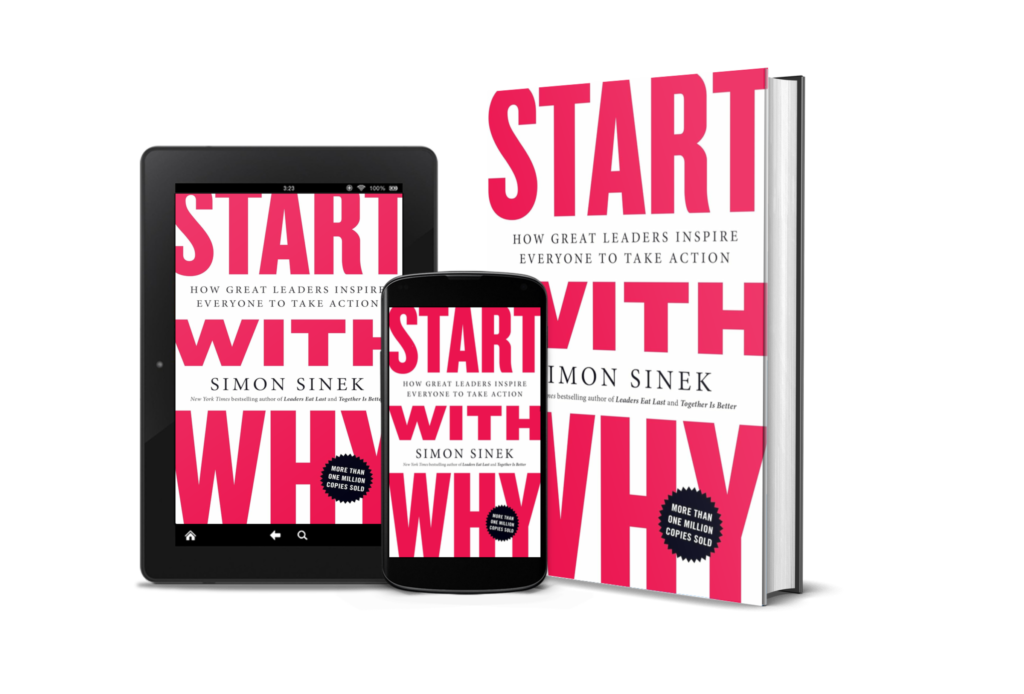
Disclaimer: “We are sharing the Best Business Books with you! Note that we might earn a small commission if you use our links, but your success in Leadership is our only goal. The price is not affected.”
4.6 ⭐⭐⭐⭐⭐ out of 5 stars (24,567)
👉 The Bestseller You Need: Grab Your Copy and Discover the Secret.
The “Start with Why” 10 Key Lessons, Summary, Main Idea, and Story, About the Author: Simon Sinek, Key Takeaways, Video, Pros and Cons, and FAQs
Introduction:
The Question That Changes Everything
Simon Sinek’s Start with Why—with a compelling 24,500+ ratings at 4.6 stars—did more than just introduce a new model; it fundamentally shifted the conversation about leadership, marketing, and human motivation. In a world obsessed with what we do and how we do it, Sinek posed a deceptively simple question that cuts to the core of influence: “Why?”
This book argues that while anyone can describe what they sell or how it’s different, only the most inspiring leaders and organizations can clearly articulate why they exist beyond making a profit. This “Why” isn’t about money—it’s a cause, a belief, a purpose. Understanding this distinction is the key to building loyal movements, not just customer bases.
Let’s explore the Golden Circle, the biological truths behind it, and how moving from the outside in (What → How → Why) to the inside out (Why → How → What) can transform not just your business, but your sense of purpose in your work and life.
Here is your guide to the power of “Why”:
The Main Idea: The core, transformative idea is that people don’t buy what you do; they buy why you do it. Actions and communications that start with a clear sense of purpose (the Why) resonate on a deeper, more instinctual level, building loyalty and inspiration that features and benefits alone cannot achieve.
A Detailed Summary: We’ll dissect Sinek’s central model: The Golden Circle.
- WHY: Your purpose, cause, or belief. Why does your organization exist? Why do you get out of bed in the morning? (This is the core).
- HOW: The specific actions or differentiating principles that bring your Why to life. These are your values or guiding processes.
- WHAT: The products you sell, the services you offer, the job titles you hold. This is the tangible result of your Why.
Most organizations communicate from the outside in (WHAT → HOW → WHY). Inspired ones communicate from the inside out (WHY → HOW → WHAT).
The Real Story: The potency of this model isn’t just philosophical; it’s biological. Sinek links it to the “Golden Ratio” of the human brain. The What corresponds to the neocortex (responsible for rational, analytical thought and language). The Why taps into the limbic system (responsible for feelings, trust, loyalty, and all human behavior and decision-making). Communicating from the Why speaks directly to the part of the brain that drives action. (While Sinek explains the why behind persuasion, Robert Cialdini’s Influence provides the essential, research-backed how—the six universal principles of ethical persuasion that make your “Why” practically effective).
Lessons for Today – Purpose-Driven Work:
- Differentiation in a Crowded Market: In a world of similar features and quality, a clear, authentic Why is the ultimate differentiator. It’s why people choose Apple over Dell, or Patagonia over another outdoor brand.
- Building a Loyal Tribe: A Why attracts people who believe what you believe. This creates employees who are engaged believers, not just hired hands, and customers who are advocates, not just transactions.
- The Clarity Filter: A clearly defined Why acts as a filter for every decision, from hiring to product development to partnerships, ensuring consistency and authenticity.
Key Takeaways for Leaders:
- The Law of Diffusion of Innovation: Success hinges on attracting your “Early Adopters”—the 13.5% of the population who believe what you believe—who will then help you cross the “chasm” to the mainstream.
- Authenticity is Non-Negotiable: You cannot fabricate a Why. You must discover it and have the courage to live by it. The market spots inauthenticity instantly.
- Leadership Requires Two Things: A vision of the world that does not yet exist (the Why) and the ability to communicate it effectively.
The Good & The Bad – Simple but Powerful:
- The Good: It presents a wildly transformative and elegantly simple framework that reframes success. It provides a powerful lens through which to view leadership, marketing, and personal motivation. Its biological basis makes it credible and universally applicable.
- The Bad: The concept, while powerful, can feel abstract and difficult to operationalize. Many leaders are left asking, “Great, but how do we actually run the company this way day-to-day?” (For the practical operating system to implement a purpose-driven vision with accountability and traction, Gino Wickman’s Traction provides the essential, structured business framework that brings a “Why” to life.)
5 Steps to Finding Your Why:
- Look at Your Past: Identify recurring themes in the moments you felt most fulfilled, proud, and engaged in your work or life.
- Gather Your Stories: Collect specific, detailed stories from others about when they saw you at your best. Look for patterns in their language.
- Draft a Statement: Create a simple draft: “To ____ so that ____.” The first blank is your contribution, the second is the desired impact.
- Test for Resonance: Share it with trusted colleagues or friends. Does it ring true? Does it give them chills? Does it provide clarity?
- Refine and Live It: Use it as a daily filter for decisions and communications. A true Why is not a slogan; it’s a compass.
Straight Answers About Purpose and Profit to see human motivation.
Related: Blue Ocean Strategy
Main Idea and Summary
The Main Idea
The central, transformative idea is that truly influential leaders and organizations think, act, and communicate from the inside out of The Golden Circle. They start with WHY (their purpose, cause, or belief), then move to HOW (the unique values and principles that bring the WHY to life), and finally to WHAT (the tangible products, services, or results). This pattern aligns with how the human brain makes decisions—the limbic brain (responsible for feelings, trust, and loyalty) processes WHY, while the neocortex (rational and analytical) processes WHAT. Inspiring action requires speaking to the limbic brain first.
Summary
“Start with Why” introduces The Golden Circle, a concentric circle model with WHY at the center, surrounded by HOW, and then WHAT. Sinek uses iconic examples like Apple, Martin Luther King Jr., and the Wright Brothers to illustrate that those who lead with WHY (e.g., “Think Different,” “I Have a Dream”) inspire lasting loyalty and change. The book explains the difference between leaders who manipulate (with price, promotions, fear) to get results and those who inspire people to act out of a shared sense of purpose. It also introduces concepts like “The Law of Diffusion of Innovations” to explain how movements spread and the critical importance of “The Celery Test” for ensuring alignment in actions.
About the Author: Simon Sinek
Simon Sinek is an unshakable optimist and a visionary thinker who teaches leaders and organizations how to inspire people. Trained as an ethnographer, he began his career in advertising but grew disillusioned with manipulative tactics. His quest to understand what makes some leaders and organizations truly influential led to the formulation of “The Golden Circle.” The TED Talk based on this book is one of the most viewed of all time, catapulting him to global fame. Sinek’s authority comes from his unique ability to synthesize patterns from history, biology, and anthropology into a simple, actionable model for modern leadership.
🔑 The 10 Key Lessons from “Start with Why.”
| # | Key Lesson | The Core Principle & Application |
|---|---|---|
| 1 | The Golden Circle: Always Start with WHY | Principle: Communicate from the inside out (Why → How → What), not outside in. Application: In your next pitch, presentation, or mission statement, lead with your purpose, belief, or cause before describing your product or service. |
| 2 | People Don’t Buy What You Do, They Buy Why You Do It | Principle: Transactions are rational. Loyalty is emotional. Customers and employees align with your purpose, not just your output. Application: Reframe marketing from listing features to telling the story of your belief. |
| 3 | The Biology of Belief: Speak to the Limbic Brain | Principle: The limbic brain controls emotion, trust, and decision-making but has no capacity for language. We rationalize decisions with facts (neocortex) after making them emotionally. Application: Use metaphors, stories, and symbols to communicate your WHY, as they bypass pure logic and connect directly with feeling. |
| 4 | The Law of Diffusion of Innovations | Principle: Movements spread through a population: Innovators (2.5%), Early Adopters (13.5%), Early Majority (34%), Late Majority (34%), Laggards (16%). Success depends on crossing the “chasm” to the Early Majority. Application: Don’t market to the masses. Focus all energy on your “true believers” (Innovators & Early Adopters) who share your WHY; they will bring in the rest. |
| 5 | Hire People Who Believe What You Believe | Principle: Skills can be taught. Attitude and belief alignment cannot. People hired for skill will work for your money. People hired for belief will work for your cause with blood, sweat, and tears. Application: Structure interviews to discover a candidate’s personal values and beliefs, not just their resume. |
| 6 | The Celery Test: Alignment is Everything | Principle: If you know your WHY, any decision can be measured against it. If a company’s WHY is “to empower people to eat healthier,” should they sell high-sugar soda? (The Celery Test says no.) Application: Use your clearly defined WHY as a filter for every strategic decision, partnership, and product line. |
| 7 | Manipulation vs. Inspiration | Principle: Manipulation (price drops, promotions, fear, peer pressure) drives transactions but erodes loyalty and profit. Inspiration (shared purpose) builds loyalty and sustainable advantage. Application: Audit your sales and marketing tactics. Are you persuading with carrots and sticks, or are you attracting people who already believe what you believe? |
| 8 | The Importance of the “Why Guy” and the “How Guy” | Principle: Visionary WHY-types (like Steve Jobs) imagine the future and inspire but can be impractical. HOW-types (like Steve Wozniak) build systems and processes to bring the vision to life. Both are critical; one sets the destination, the other builds the road. Application: Know your own type and partner with its complement. A solo founder must consciously develop the other skill set. |
| 9 | Clarity, Discipline, Consistency | Principle: Knowing your WHY isn’t enough. You need the discipline to stay true to it (The Celery Test), the consistency to repeat your message, and the clarity to communicate it simply. Application: Repeat your WHY constantly. Every leader in the organization should be able to articulate it simply and consistently. |
| 10 | Why Is a Belief, Not a Metric | Principle: Your WHY is a statement of contribution and impact on others, not a goal to be achieved. It’s the cause you serve, not a target to hit. Application: Your vision (WHAT you will achieve) should be measurable. Your mission (HOW you will do it) should be actionable. Your WHY is the timeless belief underneath it all. |
💡 The 5 Pillars of the “Start with Why” Philosophy
| Pillar | What It Is | The Critical Question to Ask |
|---|---|---|
| P1: The Core Belief (Discovering Your WHY) | The central, enduring purpose that inspires you and serves others. It’s your contribution. | “What is your cause? What is your belief? Why does your organization exist beyond making money?” |
| P2: The Guiding Principles (Defining Your HOW) | The specific actions, values, and culture you will embody to bring your WHY to life. | “How will we behave to make our WHY a reality? What are our non-negotiable values?” |
| P3: The Tangible Proof (Manifesting Your WHAT) | The products, services, and results that serve as proof of your WHY. They are the result of your belief. | “What do we actually do, make, or provide? Does every ‘WHAT’ we offer pass The Celery Test for our WHY?” |
| P4: The Communication Discipline (The Golden Circle in Action) | The non-negotiable practice of communicating from the inside out in all forums. | “In every message, am I starting with WHY, then explaining HOW, and only then describing WHAT?” |
| P5: The Culture of Believers (Hiring & Leading) | Building an organization of people who share your belief, not just possess skills. | “Are we hiring for pedigree and skill, or for belief and cultural fit? Do our people work for a paycheck or a purpose?” |
📌 Key Takeaways from the Book
- The Pattern is Universal: From Apple to the civil rights movement, the most inspirational leaders and organizations follow the same inside-out communication pattern.
- It’s About Belonging: A clear WHY gives people a sense of belonging to something bigger than themselves. This is a powerful human motivator.
- Profit is a Result, Not a Cause: Companies that lead with WHY are more profitable, innovative, and resilient, but profit is the result of their clarity, not the driver of it.
- Trust is Built on Consistency: When your WHATs and HOWs are consistently aligned with your WHY, you build deep, limbic-brain-level trust with customers and employees.
- Anyone Can Learn It: Inspirational leadership is not a genetic trait; it is an observable, learnable pattern of behavior and communication.
✅ Pros and ❌ Cons
| It can Seem Over-Simplified. The real-world work of discovering and codifying an authentic WHY for a complex organization is profoundly difficult, which the book sometimes glosses over. | ✅ Pros (Advantages) | ❌ Cons (Considerations) |
|---|---|---|
| Framework & Simplicity | Powerfully Simple & Memorable Model. The Golden Circle is incredibly easy to grasp, remember, and start applying immediately to your messaging. | Can Seem Over-Simplified. The real-world work of discovering and codifying an authentic WHY for a complex organization is profoundly difficult, which the book sometimes glosses over. |
| Inspirational Power | Deeply Inspiring and Visionary. It lifts the reader from tactical thinking to purpose-driven leadership. It changes how you see the world. | Lacks Detailed Implementation Blueprint. It is brilliant at diagnosing the “what” and “why,” but lighter on the detailed “how” of organizational change for an existing company. |
| Examples & Storytelling | Iconic, Persuasive Examples. The use of Apple, MLK, and the Wright Brothers makes the theory concrete and compelling. | Survivorship Bias. Examples are drawn almost exclusively from massive successes. It’s harder to find examples of companies with a clear WHY that failed for other reasons. |
| Universal Application | Applies to Life, Not Just Business. The framework is just as useful for a teacher, a non-profit, or someone defining their personal career path. | The “Finding Your Why” Process is Abstract. The book doesn’t provide a step-by-step workshop for a leadership team to discover their WHY, which has led to a cottage industry of consultants filling the gap. |
| Impact on Leadership | Fundamentally Changes Leadership Communication. Once you see The Golden Circle, you cannot unsee it. It becomes a filter for evaluating all communication and strategy. | Risk of “Why-Washing.” The concept can be co-opted superficially, leading to inauthentic corporate slogans that aren’t backed by action, which damages trust more than having no stated WHY. |
❓ Frequently Asked Questions (FAQs)
1. How do I actually find my company’s or my personal WHY?
Sinek later addressed this in depth with the “Find Your Why” book and workshops. The process involves reflective storytelling: mining your past for consistent patterns of fulfillment, identifying moments when you felt most impactful, and distilling the common thread into a simple, actionable statement: “To ____ so that ____.”
2. Can a company’s WHY change?
A genuine WHY should be timeless. It is a belief, not a strategy. Your HOW (strategy) and WHAT (products) will and should evolve, but the core WHY should remain constant. If it changes, it likely wasn’t the true WHY to begin with.
3. What if my company’s WHY is just “to make money”?
Sinek argues this is a result, not a cause. It does not inspire loyalty or differentiation. He would push you to ask: “What do you believe about the world? What change do you want to create? Why does the world need your company to exist?” The profit funds the cause; it is not the cause itself.
4. Is this just for the CEO, or for everyone in the organization?
For maximum impact, everyone should know the WHY. The leadership’s job is to champion and protect it. Each team and individual should then understand how their specific role (their WHAT) contributes to that overall WHY, which creates alignment and intrinsic motivation.
5. How does this relate to Mission, Vision, and Values?
Sinek’s framework often clarifies these terms: WHY = Your core purpose/cause/belief. HOW = Your values and guiding principles (this is often the “Mission” as an action statement). WHAT = Your vision (the future you’re trying to create) manifested as products/results.
6. What’s a common mistake people make when applying this?
The biggest mistake is jumping straight to crafting a catchy “Why statement” without doing the hard work of discovery. This leads to generic, inauthentic slogans. The second mistake is not using The Celery Test, so their actions (WHAT) become misaligned with their stated WHY, breeding cynicism.
👉 The Real Journey Starts Here: Turn Inspiration into Action. Get Your Copy Now.
Final Verdict
“Start with Why” is a 4.6-star classic that delivers one of the most influential and enduring business ideas of the 21st century. It provides a lens that permanently alters how you view leadership, marketing, and human motivation. While it is more of a powerful manifesto than a detailed implementation manual, its core insight is invaluable.
Buy it if: You are a leader, entrepreneur, marketer, or anyone who wants to inspire action rather than just manipulate behavior. You’re looking for a foundational philosophy to build a loyal team or customer base.
Skip it if: You need a concrete, step-by-step business plan, detailed management tactics, or are deeply skeptical of seemingly “soft” concepts. Read this for direction, not for day-to-day operations.
Rating: 4.6/5 Stars — A seminal work that defines the difference between simply running a business and leading a movement. Its simple power is its greatest strength.
StartWithWhy #SimonSinek #Leadership #GoldenCircle #InspirationalLeadership #PurposeDriven