
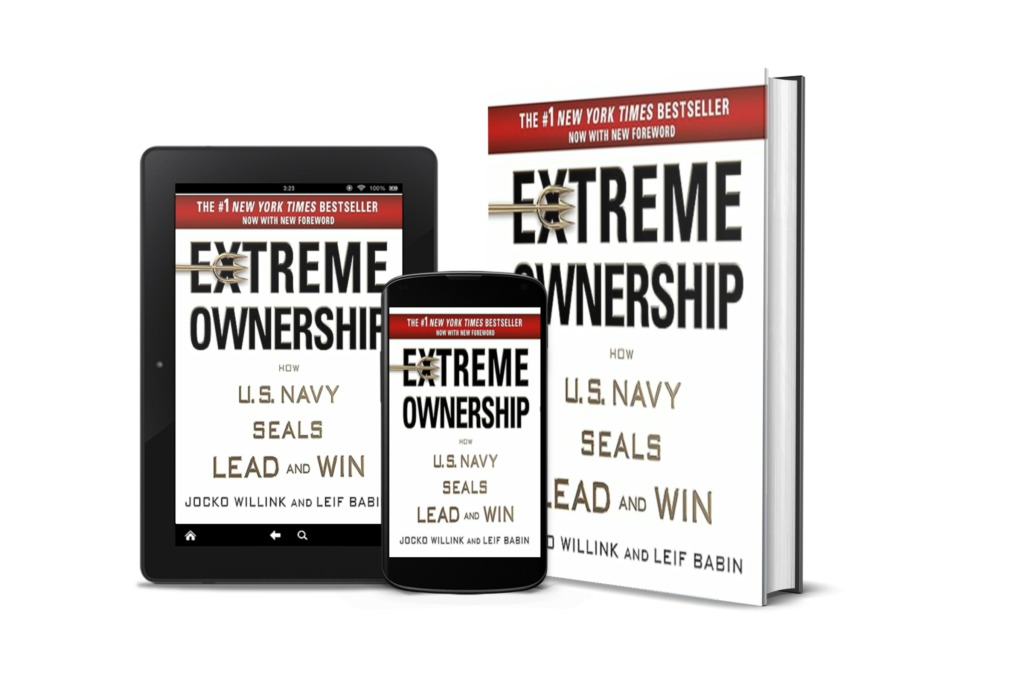
The “Extreme Ownership” 10 Key Lessons, Summary, Main Idea, and Story
About the Authors: Jocko Willink & Leif Babin, Key Takeaways, Video, Pros and Cons, and FAQs
4.8 ⭐⭐⭐⭐⭐ out of 5 stars (38,565)
👉 See why 38,565+ readers love this book
Introduction
Have you ever seen a team fail and immediately heard the leader blame the equipment, the schedule, or the resources? That’s common, but it’s not how high-stakes, successful teams operate. **Extreme Ownership** by Jocko Willink and Leif Babin is a radical manual for leadership built on a single, uncompromising principle: **The leader is 100% responsible for everything that happens in their world.**
Based on their experience as U.S. Navy SEAL commanders, the authors translate brutal combat lessons into actionable business and life principles. This book doesn’t offer soft management theories; it offers a culture of absolute accountability.
**In this comprehensive Extreme Ownership Summary, you will discover the following:**
* **The Core Principle:** How taking full ownership eliminates excuses and fosters a high-performance culture. (For the business system to execute this discipline, read our review of **Traction Book** ).
* **Combat to Business:** Detailed, real-world examples of how SEAL principles apply to corporate challenges.
* **10 Key Lessons:** A blueprint for decentralized command and mission clarity.
* **Discipline & Execution:** The non-negotiable role of personal discipline in leadership. (To master the tiny habits necessary for extreme discipline, check out **Atomic Habits Book**).
* **Pros and Cons:** An honest look at the demanding nature of this leadership philosophy.
* **FAQs:** Clear answers on how to implement Extreme Ownership in your daily life and team.
If you’re ready to stop making excuses and start achieving breakthrough results, this book is your new standard.
For Leadership and Discipline (Extended Analysis):
If you are ready to implement the discipline needed for the EOS system, find a different, extended analysis of this highly related book on our partner site:
The “Extreme Ownership” 10 Key Lessons, summary, and Main Idea
About the Author: Ramit Sethi, Key Takeaways, video, Pros and Cons, and FAQs
🎯 Main Idea and Summary: The Laws of Combat for Life
Main Idea
The central idea of “Extreme Ownership” is that leaders must own everything in their world. There is no one else to blame. If your team isn’t performing, it’s on you. If a mission fails, it’s on you. This principle of total responsibility is the bedrock upon which all other leadership principles are built. Willink and Babin argue that this mindset—adopted from the most high-stakes environments—is the single greatest factor in creating victorious teams in business, sports, and life.
Summary
Jocko Willink and Leif Babin deliver a gut-punch of a leadership manual that is both terrifying and liberating. The book’s structure is powerful: each chapter opens with a gripping, first-person story from combat in Iraq, then extracts the core leadership principle from that life-or-death scenario, and finally applies it directly to a business case from their consulting firm. They introduce the “Laws of Combat”—Cover and Move, Simple, Prioritize and Execute, and Decentralized Command—and show how they create clarity, alignment, and relentless execution in any organization. The audiobook, narrated by the authors with palpable intensity, is the definitive way to experience it.
The Day I Stopped Blaming QA and Started Leading Story
The Ramadi of the Server Room
Mark ran the “Phoenix” team, a small but critical unit responsible for developing the core analytics engine at a fast-growing tech firm. For months, they’d been bleeding time on Project Vanguard, a flagship product constantly hampered by last-minute bugs and scope creep. Mark felt the pressure mounting—from his boss, from the sales team, and from his own tired developers.
He knew the blame culture was toxic, but he was drowning in it.
The final straw came on a Tuesday when a mission-critical security vulnerability was discovered just hours before a planned launch. Mark called an emergency meeting. Before he could speak, the familiar finger-pointing began:
“It was QA’s fault for missing it in testing.” “No, it was Sales; their requirements changed five times last week.” “The backend team gave us a slow deployment pipeline; we couldn’t test properly!”
Mark stood there, absorbing the accusations, ready to deflect the blame to the external factors—the vague requirements, the tight deadlines, the “bad” team members.
The Liberating Truth: “I Own It”
That night, drained and defeated, Mark listened to a familiar, gravelly voice in his headphones: Jocko Willink’s audiobook. He heard the principle hammered home: Extreme Ownership.
There are no bad teams, only bad leaders.
It hit him like a physical punch. Every failure, every missed deadline, every toxic finger-point in that conference room was a direct result of his leadership. He hadn’t communicated the Commander’s Intent clearly. He hadn’t simplified the plan. He hadn’t led the chain, and he certainly hadn’t owned the blame. His ego was the barrier.
The next morning, Mark called the team back in. He didn’t rant or fire anyone. He simply waited for the inevitable argument about the vulnerability to start.
“Stop,” he said, holding up a hand. His voice was calm, but absolute. “I know where the blame lies.”
Every person in the room tensed, expecting a termination.
“It lies with me,” Mark stated. “I am the leader of the Phoenix team. The security vulnerability, the communication breakdown with QA, the vague requirements—I own it all. I failed to ensure the plan was simple, I failed to set up proper Cover and Move with QA, and I failed to provide crystal-clear Commander’s Intent.”
A silence fell over the room. The defensiveness vanished, replaced by confusion, and then, surprisingly, relief.
The Fix: From Blame to Blueprint
By taking ownership, Mark wasn’t accepting martyrdom; he was seizing control. He cut off the blame cycle and forced the entire team to look for solutions.
- Prioritize and Execute: He immediately identified the single highest priority: “Stabilize the build and ship a hotfix within 48 hours.” Everything else—new features, future deadlines, the post-mortem—was secondary.
- Cover and Move: He didn’t delegate the problem to the junior staff. Mark personally sat down with the QA lead and the lead developer. “We are one team, and we are not supporting each other,” he admitted. He established a new, simple protocol: mandatory daily alignment meetings and clear, shared visibility into each other’s testing environments. They moved together, supporting each other’s flanks.
- Discipline Equals Freedom: They spent the rest of the week tightening their core processes—simplifying deployment scripts and clarifying requirements (Discipline). By the following month, those processes ran so smoothly they had time for high-value innovation (Freedom).
The Phoenix team didn’t become perfect overnight, but their culture transformed. When the next bug appeared, a junior developer immediately stepped up and said, “I spotted this gap in my code, but I should have escalated sooner. I own this.”
He wasn’t punished. He was praised for taking Extreme Ownership—a mindset that had finally trickled down from a leader who learned that the ultimate freedom in leadership comes from embracing total, unadulterated responsibility.
👨💻 About The Authors: Jocko Willink & Leif Babin
Jocko Willink and Leif Babin are decorated former U.S. Navy SEAL officers who commanded SEAL Team Three’s Task Unit Bruiser in the Battle of Ramadi. They now lead Echelon Front, a leadership consulting company.
- Background: Both are recipients of the Silver Star and Bronze Star for their valor and leadership in combat. They have trained and led hundreds of SEALs.
- Expertise: Their expertise is not academic; it is forged in the most extreme leadership laboratory on earth. They teach principles that have been proven to work when the stakes are ultimate.
- Media Presence: Jocko hosts the top-rated “Jocko Podcast” and is a bestselling author. They are sought-after speakers who have transformed the culture of countless Fortune 500 companies.
- Goal: With “Extreme Ownership,” they aim to disseminate the leadership principles that enable SEAL teams to win on the battlefield, so that other leaders can win in their own arenas.
Related: Traction: Get a Grip on Your Business
🔑 10 Key Lessons from “Extreme Ownership”
The 10 key lessons distill the SEAL leadership ethos into a non-negotiable framework for winning.
| Phase | Key Lesson | Action/Insight |
|---|---|---|
| The Mindset | 1. Extreme Ownership | You must own all failures, shortcomings, and uncertainties. There is no one else to blame. Your team’s performance is a direct reflection of your leadership. |
| 2. There Are No Bad Teams, Only Bad Leaders | Leadership is the single greatest factor in a team’s performance. If a team is failing, the leader must look in the mirror and fix themself first. | |
| 3. Believe in the Mission | A leader must not only understand the “why” behind the mission but also believe in it fully. If they don’t, they must drill down until they find a reason to believe or have the integrity to voice their concerns up the chain. | |
| The Laws of Combat | 4. Cover and Move | This is teamwork. Different departments and teams must support each other and work together toward the strategic goal. Siloes and infighting destroy the mission. |
| 5. Simple | Plans and orders must be simple, clear, and concise. Complexity leads to confusion and mission failure. Simplify the message to ensure everyone understands. | |
| 6. Prioritize and Execute | In chaos, a leader must remain calm, identify the highest priority task, and execute on it. Then, move to the next priority. You cannot be overwhelmed by everything at once. | |
| The Execution | 7. Decentralized Command | Team leaders must be empowered to make decisions. The overall leader must communicate the “Commander’s Intent” (the goal and why) so junior leaders can take initiative within that framework. |
| 8. Lead Up and Down the Chain | A leader is not just responsible for their direct reports. They must also manage their boss, providing solutions and context to ensure the entire team is aligned and supported. | |
| The Culture | 9. Discipline Equals Freedom | The more disciplined a team is in the fundamentals, the more freedom and autonomy they have to execute and innovate. Discipline is not a restriction; it is a liberation. |
| 10. Act Decisively in the Face of Uncertainty | It is better to make a decision—even an imperfect one—with 70% of the information than to wait for 100% and be paralyzed. A leader must act. |
💡 Key Takeaways from the Book
- Ego is the Enemy: The number one barrier to practicing Extreme Ownership is your own ego. You must detach from your ego to see the truth and implement solutions.
- It’s a Mindset, Not a Title: Leadership is a mindset of responsibility that anyone, at any level, can adopt. You don’t need a title to lead.
- Clarity is Kindness: Being brutally honest and providing crystal-clear direction is the kindest and most effective thing a leader can do. Ambiguity is a cancer.
- Win in the Field, Win in Life: The principles that win wars are the same principles that win in business, in families, and in personal challenges.
✅ Pros and ❌ Cons of “Extreme Ownership”
| Feature | ✅ Pros (Advantages) | ❌ Cons (Disadvantages) |
|---|---|---|
| Narrative | Unforgettable & Gripping: The combat stories are visceral and powerful, making the leadership lessons stick in your mind forever. | Intense & Dogmatic: The “no excuses, ever” tone can be overwhelming and may feel too rigid for some corporate or creative cultures. |
| Actionability | Framework for Any Problem: The Laws of Combat provide a clear mental checklist for diagnosing and solving almost any team-based problem. | Requires Total Humility: Implementing this requires a level of self-honesty and humility that many people find extremely difficult to sustain. |
| Relevance | Universally Applicable: The principles are fundamental to human dynamics and work for CEOs, managers, teachers, and parents. | Oversimplifies Some Scenarios: The “no bad teams, only bad leaders” mantra, while powerful, can be an oversimplification in complex, systemic failures. |
| Impact | Culture-Transforming: Adopting this philosophy can single-handedly turn a culture of blame into a culture of solutions and accountability. | Can Be Misinterpreted: Without nuance, “Extreme Ownership” can be misused to justify toxic leadership or blame-shifting onto junior leaders. |
💡 5 Root Causes of Team Failure (And The SEAL Solution)
| Problem | The Common Trap | The SEAL Lesson / The Solution |
|---|---|---|
| P1: The Blame Game | When things go wrong, teams devolve into finger-pointing and defensiveness, destroying trust. | Practice Extreme Ownership. The leader immediately says, “I own this. This is my failure.” This stops the blame cycle and forces a focus on solutions. |
| P2: Lack of Alignment | The team is busy but working at cross-purposes because they don’t understand the strategic goal. | Simplify the Commander’s Intent. The leader must constantly reiterate the mission’s goal and purpose until every single member can repeat it. |
| P3: Initiative Paralysis | Junior team members wait for orders, afraid to make a move without explicit permission. | Implement Decentralized Command. Empower frontline leaders by giving them clear intent and trusting them to make tactical decisions. |
| P4: Overwhelm & Chaos | A team is swamped by multiple problems and doesn’t know where to start, leading to inaction. | Prioritize and Execute. The leader must stand back, identify the single most critical problem, direct the team to solve it, and then move to the next. |
| P5: Complicated Plans | A complex, multi-step plan is created, but the team on the ground misunderstands or cannot execute it. | Keep it Simple. Strip every plan and communication down to its absolute essence. If a plan can be misunderstood, it will be. |
👉 From Post to Purpose: Make the Next Breakthrough Your Reality. Purchase Your Audiobook.
❓ Frequently Asked Questions (FAQs)
Is this book only for people in the military or corporate leadership?
Absolutely not. While the authors are military and the business applications are clear, the principles are for anyone who leads or is part of a team. Parents, coaches, teachers, and individual contributors can all use Extreme Ownership to improve their effectiveness and take control of their environment.
What is the most challenging principle to implement?
For most people, it’s Leading Up the Chain. It requires the humility to take ownership of problems your boss might have created, and the courage to go to them with a solution, not a complaint. It’s about making your boss’s job easier to ensure the entire team wins.
How is this different from other leadership books?
Most leadership books are theoretical. “Extreme Ownership” is primal. The lessons are learned in an environment where failure means death, not a missed quarterly target. This stakes change the weight of the message entirely. It’s not a suggestion; it’s a law.
Can the “Extreme Ownership” mindset lead to burnout?
Only if misunderstood. Extreme Ownership is not about working 100-hour weeks and taking the blame for things truly outside your control. It’s about focusing your responsibility on the things you can influence: your actions, your decisions, and your team’s understanding of the mission. It’s about control, not martyrdom.
People Also Ask
What does “Extreme Ownership” mean?
Extreme Ownership is the practice of a leader taking complete and total responsibility for everything that happens to their team. This means owning all failures, mistakes, and shortcomings—even those caused by subordinates—and leading the effort to find a solution, without blaming anyone else.
Who are the authors of Extreme Ownership?
The authors of Extreme Ownership are Jocko Willink and Leif Babin, both decorated retired U.S. Navy SEAL officers who led SEAL teams in the Battle of Ramadi, Iraq. They are the founders of the leadership consulting firm Echelon Front and co-hosts of related leadership content.
👉 Don’t Let This Feeling End! Dive Deeper and Change Your Life—Your Full Guide Awaits.
Final Verdict
‘Extreme Ownership’ is not just a leadership book; it is a wake-up call. Willink and Babin’s unrelenting philosophy is as challenging as it is effective. This book will not comfort you—it will arm you. In a world full of excuses, it provides the intellectual and moral framework for absolute victory.
Buy if you are ready to shed your ego, embrace total responsibility, and build a team that is disciplined, aligned, and capable of winning any objective.
Rating: 4.8/5 stars— A brutal, essential, and life-altering doctrine on leadership.
Tags:
Extreme Ownership
Jocko Willink
Leif Babin
Navy SEAL Leadership
Business Management
Team Accountability
Discipline Equals Freedom
Echelon Front
Leadership Principles
Jocko Podcast