
Disclaimer: Our site may earn a small commission on products purchased through our links. Your price remains unchanged—this guarantees our honest recommendations.
4.8 ⭐⭐⭐⭐⭐ out of 5 stars (4,463)
👉 The Bestseller You Need: Grab Your Copy and Discover the Secret.
The “Crucial Conversations” 10 Key Lessons, Summary, Main Idea, and Story
About the Author: Kerry Patterson, Joseph Grenny, Ron McMillan, and Al Switzler, Key Takeaways, Video, Pros and Cons, and FAQs
Introduction:
The Conversations That Make or Break Everything
Joseph Grenny and team’s Crucial Conversations (backed by 4,400+ ratings at 4.7 stars) tackles the single skill that defines careers, strengthens relationships, and shapes organizational culture: the ability to talk when it matters most, and when emotions are at their peak. Are you ready to stop walking on eggshells, resenting unmet expectations, or watching projects fail because the real issue was never discussed?
We’ve all been there. That moment with a colleague about a missed deadline, the feedback session with a direct report that goes sideways, the family disagreement that escalates into a silent standoff. In these crucibles, most of us either fall silent (withdrawing) or turn violent (becoming aggressive, sarcastic, or controlling). Crucial Conversations provides a third, revolutionary path: the ability to stay in authentic, respectful dialogue even when the stakes are high, opinions vary, and emotions run strong.
This isn’t about being a better public speaker. It’s about becoming a master of the private, pivotal exchanges that determine the quality of your work and your life. Let’s move from avoidance to mastery.
Your blueprint for navigating the talks you can’t afford to miss:
The Main Idea: The core premise is that the quality of your life and leadership is determined by how you handle crucial conversations—those discussions where the stakes are high, opinions differ, and emotions are intense. The book provides a field-tested toolkit to stay in “dialogue,” the free flow of meaning between people, even under pressure.
A Detailed Summary: The authors break down a repeatable framework for successful crucial conversations:
- Start with Heart: Get right with yourself first. Focus on what you really want (for the relationship, for yourself, for the other person) and refuse the “Fool’s Choice” (the false belief that you must choose between honesty and respect).
- Learn to Look: Become a master observer—of the content and the conditions. Spot the moment a conversation turns crucial, and watch for signs of silence or violence in yourself and others.
- Make It Safe: When safety is threatened (people feel disrespected or their motives are mistrusted), dialogue stops. The critical skill is to step out of the content, rebuild safety through mutual purpose and respect, and then step back in.
- Master Your Stories: We are emotional not by the facts, but by the stories we tell ourselves about the facts. The book teaches how to retrace your “Path to Action” (See/Hear -> Tell a Story -> Feel -> Act) and challenge the often-inaccurate, self-serving stories that fuel our emotions.
- STATE Your Path: How to share tough opinions. Share your S facts, tell your story, ask for others’ paths, talk tentatively, and encourage testing.
- Explore Others’ Paths: How to listen when others are in silence or violence. Use the AMPP tools: Ask, Mirror, Paraphrase, and Prime to encourage them to share their meaning.
The Real Story: The book’s power lies in its revelation that most organizational and personal failures are not strategic mistakes, but conversational failures. That missed deadline, that lost client, that fractured team—they can often be traced to a crucial conversation that was either avoided or handled poorly. (While Crucial Conversations gives you the universal framework for all high-stakes dialogue, Chris Voss’s Never Split the Difference provides a masterclass in the specific, tactical psychology of negotiation, making them powerful complementary reads.)
Lessons for Today – Communication Tools:
- Safety First, Content Second: You cannot solve a problem with someone if they don’t feel safe around you. Learn to recognize and immediately repair safety breaches.
- Focus on Mutual Purpose: The golden question to ask (and mean) is: “What do I want for me, for them, and for the relationship?” This moves you from adversarial to collaborative.
- Separate Facts from Stories: Practice the discipline of describing observable facts (“Your report was three days late”) before leaping to conclusions (“You don’t respect our team”).
Key Takeaways for Better Relationships:
- Dialogue is a Choice, Not a Feeling: You can choose skilled behavior even when you feel threatened or angry.
- The Pool of Shared Meaning: The goal of dialogue is to increase the pool of shared information and perspective. The larger the shared pool, the better the decisions and the stronger the commitment.
- Your Behavior is a Signal: Your tone, body language, and word choice are constant signals about whether the conversation is safe.
The Good & The Bad – Skill-Building:
- The Good: It is exceptionally practical and actionable. It provides clear models (like STATE and AMPP) that you can practice immediately. It’s based on decades of research with real organizations.
- The Bad: It is a skill-based toolkit, not a magic wand. Its effectiveness is directly proportional to the effort you put into practicing the skills, especially in low-stakes settings. It requires humility and self-awareness. (For the foundational character principles that make these skills authentic—like being proactive and seeking first to understand—Stephen Covey’s The 7 Habits of Highly Effective People provides the essential ethical and personal foundation).
5 Skills for High-Stakes Talks:
- Rebuilding Safety: The ability to apologize when you’ve violated respect, or to clarify mutual purpose when intentions are suspect.
- Contrasting: A “don’t/do” statement to fix misunderstandings. “I don’t want you to think I don’t value your work. I do. I want to talk about the deadline so we can meet our shared goal.”
- Telling Your Story Tentatively: Sharing your conclusion as a hypothesis, not a fact. “I’m starting to think there might be a resource issue. Is that possible?”
- Curious Listening: Using questions and paraphrasing to understand the other person’s meaning at least as well as they understand it themselves.
- Moving to Action: Ensuring dialogue leads to a clear decision (who does what by when) and a follow-up plan, so the conversation creates results.
Straight Answers About Difficult Conversations:
Related: The Hard Thing About Hard Things
Main Idea and Summary
The Main Idea
The central idea is that the quality of your life is determined by the quality of your dialogues, especially during high-stakes, emotional confrontations. When faced with a crucial conversation, we are biologically programmed to resort to “fight or flight” (silence or violence). The key to success is to recognize this moment and consciously create a “Pool of Shared Meaning”—a reservoir of all relevant facts, feelings, and perspectives—from which better decisions and stronger relationships naturally emerge.
Summary
“Crucial Conversations” presents a field-tested, seven-point model for effective dialogue:
- Start with Heart: Get right with yourself first (focus on what you really want).
- Learn to Look: Spot when a conversation becomes crucial and when people are moving toward silence or violence.
- Make It Safe: Restore safety when others feel threatened (the prerequisite for all productive dialogue).
- Master My Stories: Separate facts from the negative stories you tell yourself that drive your emotions.
- STATE My Path: Share sensitive information effectively (Share facts, Tell your story, Ask for others’ paths, Talk tentatively, Encourage testing).
- Explore Others’ Paths: Listen to understand others’ perspectives, especially when they disagree.
- Move to Action: Turn successful dialogue into clear decisions and action plans.
The book is packed with realistic examples, scripts, and practical tools for each step.
About the Authors: The VitalSmarts Team
The authors—Kerry Patterson, Joseph Grenny, Ron McMillan, and Al Switzler—are not just theorists; they are researchers and corporate trainers who founded VitalSmarts, a top leadership training company. Their work is based on studying thousands of individuals in high-stakes environments to identify the specific behaviors of those who consistently succeed in crucial moments. This third edition incorporates decades of additional research and feedback from teaching these skills to over 300 Fortune 500 companies. Their authority comes from measurable, real-world results.
🔑 The 10 Key Lessons from “Crucial Conversations.”
| # | Key Lesson | The Core Skill & Application |
|---|---|---|
| 1 | Start with Heart: Focus on What You REALLY Want | Skill: Before speaking, ask: “What do I want for myself, for the other person, and for the relationship?” This north star keeps you from getting hijacked by emotions like pride or vengeance. |
| 2 | Spot the Crucial Conversation | Skill: Recognize the signs: rising emotions, high stakes, and opposing opinions. The moment you feel stressed or scared, label it: “This is a crucial conversation.” |
| 3 | Safety First: Dialogue is Impossible Without It | Skill: When others become defensive (silence or violence), it’s a sign of danger. Stop talking about content and immediately repair safety by affirming mutual respect and purpose. |
| 4 | Master Your Stories | Skill: Emotions aren’t caused by others; they are caused by the stories we tell ourselves about others’ actions. Separate observable facts from your accusatory story. |
| 5 | The STATE Method to Speak Up | Skill: Use a formula: Share the facts (least controversial), Tell your story (what you’re concluding), Ask for their perspective, Talk tentatively (soften your delivery), Encourage testing (invite pushback). |
| 6 | AMPP to Listen When Others Are Silent/Violent | Skill: Ask to get things rolling, Mirror to acknowledge emotions, Paraphrase to show understanding, Prime if they’re still stuck (take a best guess at what they might be feeling). |
| 7 | Explore the Other Person’s Path | Skill: Genuine curiosity is your superpower. Seek to understand their “facts, story, and feelings” as vigorously as you defend your own. |
| 8 | Agree, Build, Compare—Don’t Argue | Skill: Find and agree on points you share. Build on their ideas with additions. Only then, compare your different views to find a third, better way. |
| 9 | Move from Dialogue to Decision | Skill: Clarity trumps consensus. Decide how you’ll decide (command, consult, vote, consensus) and be crystal clear on who will do what by when. |
| 10 | Practice, Practice, Practice | Skill: These are not instincts; they are learned skills. Start with low-stakes conversations to build the muscle memory for high-stakes moments. |
💡 The 5 Pillars of the Crucial Conversations Framework
| Pillar | What It Is | The Critical Question to Ask Yourself |
|---|---|---|
| P1: Self-Awareness & Intent (Start with Heart) | Managing your own internal state before and during the conversation. | “What is my true motive here? Am I trying to win, punish, or stay safe? Or am I trying to find a mutually beneficial outcome?” |
| P2: Social Awareness (Learn to Look) | Reading the room and the conversation’s emotional climate. | “Are we still in dialogue? Are people contributing to the ‘Pool of Shared Meaning,’ or are they moving toward silence (withholding) or violence (attacking/controlling)?” |
| P3: Safety Creation & Repair | The non-negotiable foundation. Building psychological safety by establishing Mutual Respect and Mutual Purpose. | “Does the other person feel respected by me right now? Do they believe we are working toward a common goal?” If no, address this BEFORE content. |
| P4: Controlled Contribution (STATE & AMPP) | The disciplined skills for speaking persuasively without offending and listening empathetically without conceding. | “Am I sharing my perspective in a way that makes it safe for others to disagree? Am I listening to understand, or just to reload my argument?” |
| P5: Decision & Action Clarity | Ensuring the dialogue leads to a clear resolution and forward motion. | “What was actually decided? Who is accountable for what specific action by what specific time? How will we follow up?” |
📌 Key Takeaways from the Book
- It’s Not About the Content, It’s About the Condition: The first breakdown in a crucial conversation is never about the topic—it’s about a violation of safety (respect or purpose).
- You Are Responsible for Your Emotions: You create your own emotions via the stories you tell yourself. Change your story, change your emotion, change the conversation.
- Dialogue is the Free Flow of Meaning: The goal is not to win, but to ensure all relevant perspectives (including your own) are added to the shared pool of understanding. Better decisions emerge from this pool.
- Silence is Violence: Withholding your perspective isn’t peacekeeping; it’s a withdrawal from the shared pool that impoverishes the relationship and the decision.
- Skills Beat Instinct: Our instincts in stress (attack or retreat) are counterproductive. These conversational skills must be learned, practiced, and applied deliberately.
✅ Pros and ❌ Cons
| Aspect | ✅ Pros (Advantages) | ❌ Cons (Considerations) |
|---|---|---|
| Framework & Structure | Exceptionally Practical & Structured. Provides a clear, repeatable model (STATE, AMPP) with concrete scripts and steps, not just theory. | Can Feel Formulaic. The scripts can seem awkward at first. It takes practice to internalize the principles so they flow naturally. |
| Research & Examples | Backed by Immense Research & Real Examples. Draws from decades of study in corporate and personal settings, making it highly credible and relatable. | Corporate-Leaning Examples. Many workplace scenarios may feel less directly applicable to intense family or personal conflicts without some translation. |
| Universal Application | Skills for Life. The tools work with a boss, a spouse, a teenager, or a friend. It’s arguably the most transferable skill set in any personal development book. | Emotionally Demanding to Apply. The self-awareness and discipline required, especially in the heat of the moment, is significant. It’s hard work. |
| Focus on Safety | Game-Changing Insight on Safety. Making “safety” the core metric transforms how you approach any conflict. This alone is worth the price of the book. | Requires a Willing Partner. The model works best when both parties are somewhat rational. It is extremely challenging with someone who is abusive or completely unwilling to engage. |
| Impact on Outcomes | Directly Improves Results. This isn’t about being nicer; it’s about being more effective. Better conversations lead to better decisions, faster innovation, and stronger trust. | Not a Quick Read for Application. You must study it, take notes, and role-play. Skimming it will not impart the skill. |
❓ Frequently Asked Questions (FAQs)
1. Is this book just for managers and businesspeople?
Absolutely not. While packed with business examples, the principles are human. The chapters on managing family conflicts, talking with teens, and dealing with difficult friends are equally robust. Anyone in any relationship can benefit.
2. How is the Third Edition different from previous ones?
The third edition includes updated research, fresh examples, and a sharper focus on the digital age (how to have crucial conversations via email and text). It also refines the core model based on 20+ years of teaching it globally.
3. What if the other person hasn’t read the book?
You only need one person skilled in dialogue to change the dynamic. By focusing on mutual purpose, making it safe, and listening well, you can often bring the other person back into productive dialogue, even if they’re unaware of the model.
4. Is the audiobook a good format?
Yes, particularly because it’s narrated by co-author Joseph Grenny. Hearing the tone and emphasis from one of the creators adds depth. However, this is a book you’ll want to highlight and reference, so a physical or digital copy is highly recommended as a companion.
5. How does this compare to “Nonviolent Communication” (NVC)?
They are highly complementary. NVC focuses deeply on the language of feelings and needs. Crucial Conversations provides a broader, more structured framework for the entire arc of a high-stakes talk, with a stronger emphasis on business outcomes and decision-making. Many use both.
6. What’s the single most important thing to do in a crucial conversation?
Pause and restore safety. The moment you see or feel defensiveness (in yourself or others), stop advocating for your point. Say something like, “It seems like we both want what’s best for the project, and I respect your expertise. I may have misunderstood something…” This repairs the condition so you can return to the content.
👉 “Intending to buy a book? Experience safe and easy shopping from our website.”
Final Verdict
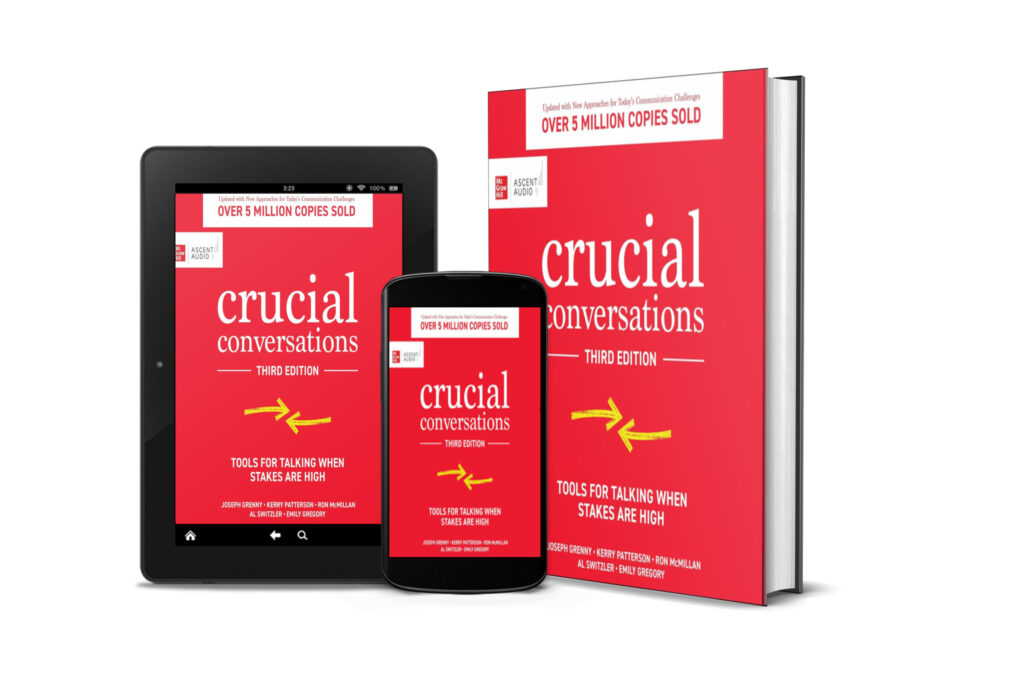
“Crucial Conversations” (Third Edition) is a 4.7-star essential masterpiece of practical psychology. It is arguably the most valuable book you can read for improving your professional trajectory, your closest relationships, and your personal peace of mind. It turns the art of difficult dialogue into a learnable science.
Buy it if: You have important relationships (professional or personal) that could be better if you avoid conflict or handle it poorly, or if your success depends on gaining alignment and cooperation from others.
Skip it if: You believe all conflict is bad and should be avoided at all costs, or if you are looking for a simple, philosophical read rather than a practical skills manual you must study and practice.
Rating: 4.7/5 Stars — A timeless, research-backed toolkit that belongs on the shelf of every leader, partner, parent, and human being who wants to turn conflict into connection and collaboration.
CrucialConversations #CommunicationSkills #ConflictResolution #EmotionalIntelligence #LeadershipDevelopment #Dialogue