
Disclaimer: Our site may earn a small commission on products purchased through our links. Your price remains unchanged—this guarantees our honest recommendations.
4.8 ⭐⭐⭐⭐⭐ out of 5 stars (15,870)
See why 15,870+ readers love this book
The “The Daily Stoic” 10 Key Lessons, Summary, Main Idea, and Story, About the Author: Ryan Holiday, Key Takeaways, Video, Pros and Cons, and FAQs
Introduction:
Ancient Wisdom for Modern Chaos
Hey. Feeling overwhelmed? Caught in the 24/7 news cycle, the pressure to perform, and the quiet anxiety of an uncertain world? You’re not alone. But what if the most potent antidote to modern chaos wasn’t a new app or therapy, but a 2,000-year-old operating system for the mind? Ryan Holiday’s The Daily Stoic (with a commanding 35,000+ ratings at 4.8 stars) does precisely that: it transforms the profound writings of Roman Emperor Marcus Aurelius, Seneca, and Epictetus from academic philosophy into a practical, daily toolkit for resilience.
We often treat ancient wisdom as something to be admired behind glass—lofty ideals disconnected from our daily commute, work deadlines, and family stress. The Daily Stoic shatters that glass. It posits that Stoicism was never meant to be debated in a lecture hall; it was designed to be lived in the marketplace, on the battlefield, and in the home. It is, at its core, the art of mental fortitude.
So, if you’re tired of feeling at the mercy of external events and your own turbulent emotions, this is your invitation. Let’s explore how a page-a-day practice can rewire your response to the world, not by changing the chaos, but by fundamentally changing your perspective within it.
Your detailed guide to cultivating an unshakeable core:
The Main Idea: Stoicism is not a theoretical philosophy; it is a practical philosophy for everyday life. Its sole purpose is to build virtue (wisdom, courage, justice, temperance) and equip you with the mental tools to endure hardship, manage desire, and navigate the world with clear-eyed calm. It’s less about what you know and entirely about how you act and react.
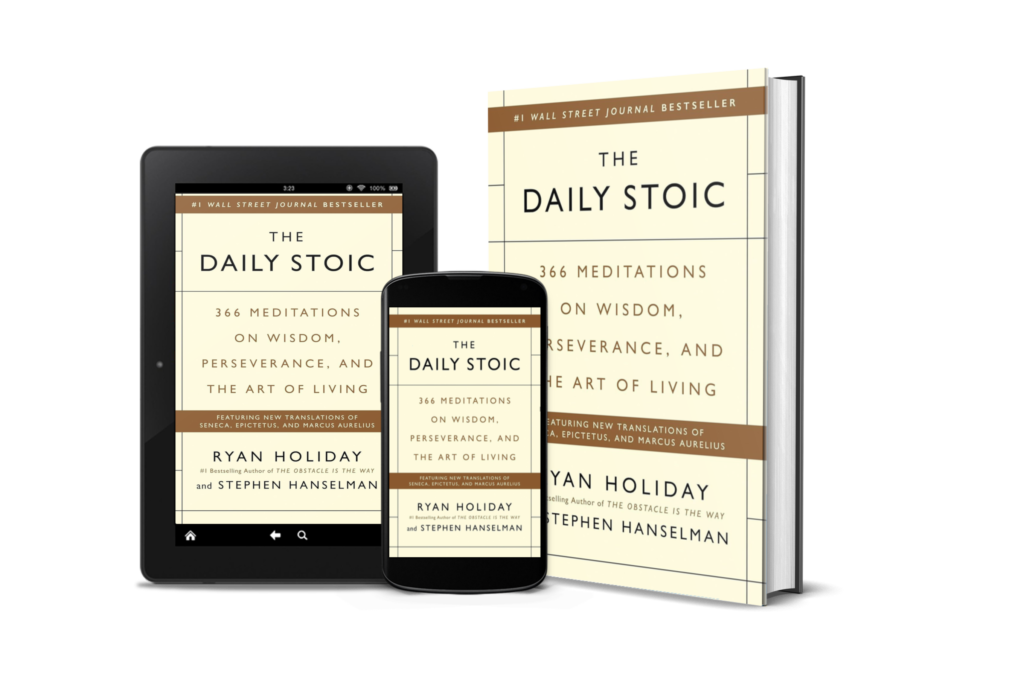
A Detailed Summary: The book’s genius is in its format: 366 daily meditations (one for each day, plus Leap Day). Each entry follows a powerful structure: a poignant quote from a Stoic thinker, followed by Holiday’s concise, modern interpretation and a direct, actionable prompt for reflection or action. This isn’t a book you read once; it’s a companion you converse with each morning, building resilience one day at a time.
The Real Story: At the heart of Stoicism is a single, life-changing dichotomy: The focus on what is within our control (our judgments, actions, and responses) and the acceptance of what is not (external events, the past, other people’s opinions). The entire practice is a training regimen to spend your finite energy exclusively on the former. (While Stoicism trains your judgment, understanding how that judgment can be flawed is critical. For a masterclass in the cognitive biases that distort our thinking, our review of Thinking, Fast and Slow provides the essential scientific backbone.
Lessons for Today – Daily Practice:
This is where philosophy becomes ritual. Key practices include:
- The Morning Premeditation: Starting the day by mentally rehearsing potential challenges—not to worry, but to prepare your calm response. This “inoculates” you against frustration.
- The Evening Review: Reflecting on the day: Where did I act with virtue? Where did I let externals disturb my peace? This is a non-judgmental course-correction.
- The Voluntary Hardship: Occasionally choosing discomfort (a cold shower, a fast, a digital detox) to prove to yourself that your peace does not depend on perfect external conditions.
Key Takeaways for Resilience:
The core Stoic beliefs that build emotional strength:
- Our Suffering is caused by Our Judgments: It’s not the event that hurts us, but our opinion of it. Changing the opinion changes the pain.
- Amor Fati (Love Your Fate): To wish for what has happened is to align yourself with reality itself. This is the ultimate formula for resilience.
- Memento Mori (Remember You Must Die): Not a morbid fixation, but a vivid reminder to prioritize what’s truly important and to act with urgency and virtue today.
- The Obstacle is the Way: A direct problem or setback is not a diversion from your path; it is the path. It is the raw material for your growth.
The Good & The Bad – Practitioner’s View:
- The Good: The daily meditation format is exceptional. It makes a dense philosophy accessible and actionable. Holiday’s interpretations are crisp, relevant, and free from dogma. It is, quite simply, one of the best possible introductions to practical Stoicism.
- The Bad: The format demands real commitment. Its power dissolves if treated as a casual read. The daily entries can sometimes feel brief, leaving you craving more depth on complex ideas. (Stoicism provides the “why” for daily discipline. For the masterful “how” of turning that discipline into an unbreakable habit, the systems in Atomic Habits are the perfect, practical complement for ensuring you actually open the book every day.
5 Stoic Practices That Change Everything:
- The Dichotomy of Control: Consistently ask, “Is this within my control?” If not, work to accept it. If so, take purposeful action.
- Journaling as Philosophical Practice: Using writing not for diary entries, but to interrogate your own judgments, plan virtuous actions, and review your progress.
- View from Above: Mentally zooming out to see your life and current problem in the context of the vast cosmos or human history—a powerful tool for reducing anxiety and gaining perspective.
- Premeditatio Malorum: The premeditation of evils. By mentally preparing for potential losses or difficulties, you rob them of their power to surprise and destabilize you.
- Practice Poverty & Minimalism: Periodically living with less to truly appreciate what you have and to sever the link between happiness and material possession.
Straight Answers About Practical Philosophy:kable inner citadel, one day at a time.
Related: The Innovator’s Dilemma
Main Idea and Summary
The Main Idea
The central idea is that tranquility, resilience, and effectiveness are not products of circumstance, but of disciplined perception and virtuous action. Stoicism provides the mental tools to distinguish between what is within your control (your thoughts, judgments, and actions) and what is not (external events, other people’s opinions). By focusing exclusively on the former, you can achieve a state of inner peace and outward effectiveness, regardless of the chaos around you. This book delivers that philosophy in bite-sized, daily exercises.
Summary
“The Daily Stoic” is a beautifully structured, year-long guide. Each page features a powerful quote from a Stoic philosopher (Marcus Aurelius, Seneca, Epictetus, etc.), followed by a concise, insightful commentary from the authors that connects the ancient wisdom to contemporary challenges—from work stress and social media envy to grief and ambition. The meditations are organized thematically by month (e.g., January on Clarity, June on Discipline, October on Virtue), creating a progressive journey. It’s designed to be read each morning or evening as a centering ritual.
About the Authors: Ryan Holiday & Stephen Hanselman
Ryan Holiday is a modern evangelist for Stoicism and one of its most accessible writers. A bestselling author, media strategist, and host of the “Daily Stoic” podcast and newsletter, he is renowned for translating complex philosophical concepts into actionable advice for entrepreneurs, athletes, and leaders. His passion is making wisdom practical.
Stephen Hanselman is a seasoned publishing professional with a Master’s in Philosophy and Theology from Harvard. He brings deep academic rigor and a lifetime of study to the project, ensuring the translations and interpretations are both accurate and profound.
Together, they form the perfect duo: Holiday provides the modern application and vibrant outreach, while Hanselman ensures scholarly integrity and depth.
🔑 The 10 Key Lessons from “The Daily Stoic.”
| Insight: Zoom out. See your problems in the vast context of history, the cosmos, or even just your whole life. It shrinks today’s drama to the proper size. Application: When stressed, ask: “Will this matter in a week? A year? On my deathbed?” | Key Lesson | The Stoic Insight & Modern Application |
|---|---|---|
| 1 | The Dichotomy of Control | Insight: Some things are up to us (our opinions, desires, aversions), and some are not. Application: Immediately categorize challenges: “Is this within my control?” If yes, act. If no, accept and manage your response to it. |
| 2 | Amor Fati (Love Your Fate) | Insight: Don’t just endure what happens—love it. See every obstacle as fuel for growth. Application: Reframe setbacks. A lost deal is practice. A criticism is a chance to improve. Say “This is for my good” to difficulties. |
| 3 | Practice Misfortune (Premeditatio Malorum) | Insight By mentally rehearsing potential losses (of job, status, loved ones), you rob future events of their power to shock and destabilize you. Application: Spend 5 minutes each morning visualizing a “worst-case” scenario and your calm, virtuous response to it. |
| 4 | Focus on Your Character, Not Your Reputation | Insight: Your reputation is not in your control; your character is your only true possession. Application: Make decisions based on what is right, not what will look good. Let your actions define you, not others’ opinions. |
| 5 | Memento Mori (Remember You Must Die) | Insight: Keeping your mortality in mind is not morbid—it’s the ultimate motivator to live purposefully and avoid pettiness. Application: Ask, “If this were my last day/week/month, would I be spending my time and energy this way?” |
| 6 | The Obstacle is the Way | Insight: The impediment to action advances action. What stands in the way becomes the way. Application: View every problem as a puzzle to solve or a skill to develop. The difficulty is the path to your goal, not a detour from it. |
| 7 | Reserve Clause (Internal Goal Setting) | Insight: Pursue goals with effort, but attach your happiness to the attempt, not the outcome. Application: Set your intention as, “I will give my best presentation,” not “I will win the client.” You control the first, not the second. |
| 8 | View from Above | Insight: Zoom out. See your problems in the vast context of history, the cosmos, or even just your whole life. It shrinks today’s drama to proper size. Application: When stressed, ask: “Will this matter in a week? A year? On my deathbed?” |
| 9 | Sympatheia (Interconnectedness) | Insight: We are all part of a single, rational community. Harm to another is harm to the whole, and thus to yourself. Application: Practice empathy. See annoying people as misguided or uninformed, not evil. Seek to understand. |
| 10 | Journaling as Philosophy in Action | Insight: The Stoics were avid journalers. Writing is how you converse with yourself, review your progress, and install new thinking patterns. Application: Use the daily meditation as a prompt for 5 minutes of reflective writing each evening. |
💡 The 5 Pillars of Daily Stoic Practice
| Pillar | What It Is | Practical Daily Ritual |
|---|---|---|
| P1: Morning Preparation | Setting your intentions and mental armor for the day ahead. | Ritual: Read the day’s page. Ask: “What challenges might I face today? How can I apply this teaching? What is within my control?” |
| P2: The Discipline of Perception | Training yourself to see events objectively, not emotionally. | Ritual: When triggered, pause. Strip the story and judgment. State the bare facts: “X happened. My colleague said Y.” Then choose your response. |
| P3: The Discipline of Action | Acting with virtue (wisdom, courage, justice, temperance) in all situations. | Ritual: Before acting, ask: “Is this just? Is this kind? Is this necessary? Is this within my control?” Let virtue be the sole metric. |
| P4: The Discipline of Will | Accepting peacefully what you cannot change. | Ritual: Practice “turning the obstacle upside down.” Find the opportunity or lesson in every frustration or denial. Say “No problem” to fate’s plans. |
| P5: Evening Review | Examining your day with honesty and a commitment to improvement. | Ritual: Journal. “Where did I act with virtue today? Where did I let externals control me? What can I do better tomorrow?” |
📌 Key Takeaways from the Book
- Philosophy is a Practice, Not a Theory: Stoicism is meant to be lived, not just debated. This book turns it into a daily workout for your mind.
- Your Mind is Your Greatest Asset and Liability: The same event can be a catastrophe or an opportunity based solely on your judgment of it. Master your perceptions.
- Antifragility is the Goal: Stoicism doesn’t just make you resilient (bouncing back); it aims to make you antifragile (growing stronger from disorder).
- Freedom is an Inside Job: True freedom is not doing what you want, but wanting what is right and being undisturbed by what you cannot control.
- A Tool for Everyone: This isn’t just for CEOs or soldiers. It’s for parents managing tempers, creatives facing rejection, and anyone feeling overwhelmed by modern life.
✅ Pros and ❌ Cons
| Aspect | ✅ Pros (Advantages) | ❌ Cons (Considerations) |
|---|---|---|
| Format & Structure | Perfect Daily Ritual. The one-page-per-day format is effortless to maintain and builds a powerful habit of reflection. | Can Feel Fragmented. Reading out of order or skipping days can dilute the thematic monthly progression. It’s best used as intended. |
| Content & Wisdom | Timeless, Actionable Wisdom. Distills profound philosophy into clear, immediately applicable lessons. The commentary is superb. | Requires Repetition & Patience. The lessons are simple but deep. Their power is unlocked through consistent re-reading and practice over years, not days. |
| Accessibility | The Best Gateway to Stoicism. Makes a potentially intimidating philosophy welcoming and relevant. No prior knowledge needed. | Depth Seekers May Want More. It’s an entry point. Those wanting deep scholarly analysis should pair it with the original texts (Meditations, Letters). |
| Physical Quality | Beautiful, Durable Edition. The “Perfect Paperback” is designed to last a year of daily use and often becomes a treasured object. | Not a Narrative. It’s a reference book and practice guide. Don’t expect a story or linear argument. |
| Impact | Life-Changing if Used Consistently. The daily practice has a compounding effect on resilience, focus, and peace of mind. | Passive Reading is Useless. The value is zero if you just read it. The value is infinite if you practice it. It demands participation. |
❓ Frequently Asked Questions (FAQs)
1. Isn’t Stoicism about being emotionless and cold?
A major misconception. Stoicism is about managing destructive, reactive passions (like blind rage or debilitating grief) through reason, not eliminating healthy emotions like joy, love, or empathy. The goal is to be guided by virtue, not hijacked by emotion.
2. Can I start this book any time, or do I have to start on January 1st?
Start today. The date on the page is just a tracking mechanism. The beauty is that you can begin your “Day 1” on any calendar day. The monthly themes are valuable but not strictly sequential.
3. What’s the best time of day to read it?
Most practitioners recommend the morning as a “philosophical priming” for the day ahead. However, an evening review is also powerful for reflection. Find a consistent time that becomes your non-negotiable ritual.
4. Is this a religious book?
No. Stoicism is a philosophy of life, not a theology. It is completely compatible with any religion or atheism. It focuses on ethics, perception, and action in this life.
5. How is this different from other daily meditation books (like The Book of Awakening)?
While other books may be spiritual or poetic, The Daily Stoic is distinctly philosophical and pragmatic. It’s less about feeling and more about thinking and doing. It provides a rational framework for problem-solving and character building.
6. I’ve read Ryan Holiday’s other books (Ego is the Enemy, etc.). Is this repetitive?
Not at all. His other books explore specific Stoic themes in depth with modern case studies. The Daily Stoic is the foundational practice manual—the daily drill that supplies the wisdom explored in his other works. They complement each other perfectly.
👉 “Intending to buy a book? Experience safe and easy shopping from our website.”
Final Verdict
“The Daily Stoic” is a 4.8-star classic for a reason. It is arguably the most effective and accessible tool ever created for installing a robust operating system for life. It turns the profound into the practical and makes ancient genius your daily companion.
Buy it if: You want a structured, no-excuses way to build mental toughness, clarity, and peace. You’re ready to commit to a simple daily practice that compounds into profound personal change.
Skip it if: You want a quick, passive read or are looking for mystical or purely emotion-based guidance. This is a manual for the rational mind and disciplined action.
Rating: 4.8/5 Stars — An essential, enduring practice that is less of a book and more of a loyal mentor, offering timeless wisdom for every single day of your year and your life.
TheDailyStoic #RyanHoliday #Stoicism #MentalResilience #Mindset #SelfMastery