
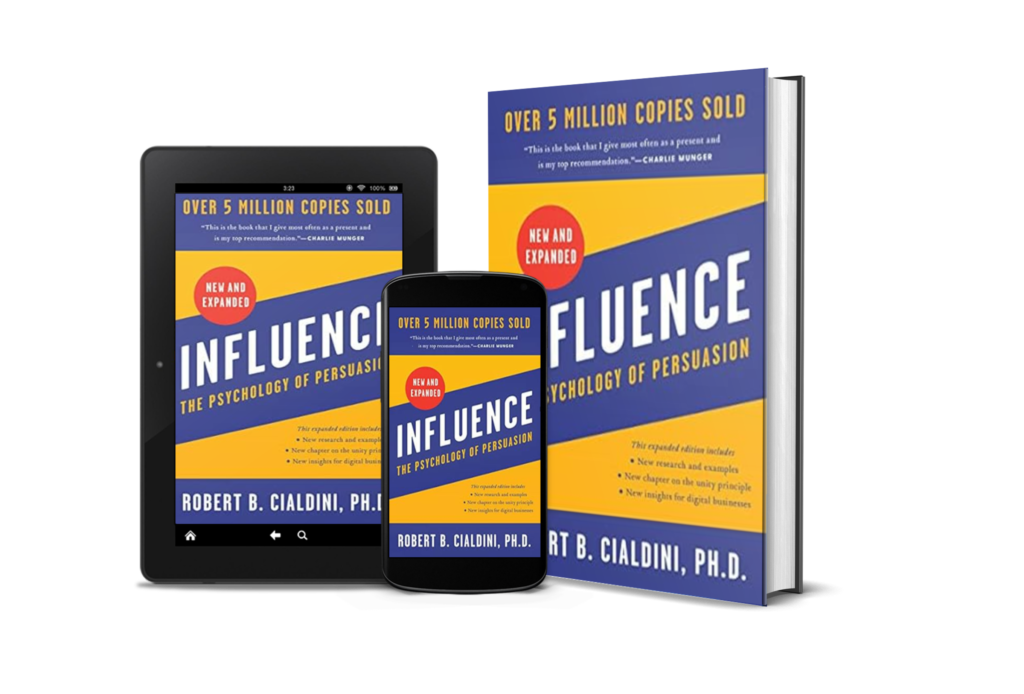
The “Influence, New and Expanded” 10 Key Lessons, Summary, Main Idea, and Story
About the Author: Robert Cialdini, Key Takeaways, Video, Pros and Cons, and FAQs
4.7 ⭐⭐⭐⭐⭐ out of 5 stars (6,931)
See why 6,931+ readers love this book
Introduction
If you’re going to read it, here’s what you’ll get out of it:
Straight Answers: I’ve included clear answers to all the questions I had when I first picked it up.
Trust me, after reading this, you’ll hear the subtle “click” of these principles being activated in everyday life, giving you the power to choose your response.
The Main Idea: The core argument that human decision-making is often driven by automatic, psychological “weapons of influence” that can be triggered ethically to foster cooperation or unethically for manipulation.
A Detailed Summary: A complete breakdown of the 7 core principles of persuasion, now including the new principle of Unity.
The Real Story: It shows you how to become both a skilled ethical influencer and an informed, resilient target. (ready for both reading and video!)
Lessons for Today: The 10 big lessons distill decades of research into actionable insights for the modern world. (To understand the underlying mental mechanics of these decisions, read our review of Thinking, Fast and Slow (Book).)
The Good & The Bad: I’ll give you my honest take on what makes this book a timeless classic and why the new content is essential.
5 Root Causes of Compliance: Apply these principles to build trust, lead effectively, and spot manipulation a mile away. (For mastering the core personal habits required for influence, check out The 7 Habits Book.)
For a Deep Dive into Power Dynamics (Extended Analysis):
Since influence often intersects with power, find a different, extended analysis of this highly related book on our partner site:
The “Influence, New and Expanded” 10 Key Lessons, summary, and Main Idea
About the Author: Dr. Robert B. Cialdini, Key Takeaways, video, Pros and Cons, and FAQs
🎯 Main Idea and Summary: The Science Behind the “Yes.”
Main Idea
The central idea of “Influence” is that in a complex world, we rely on mental shortcuts (heuristics) to make decisions. Influence masters tap into these shortcuts through seven key principles. While these principles can be used unethically for manipulation, understanding them allows us to use them ethically to create win-win outcomes and to build a robust defense against compliance professionals who do not have our best interests at heart.
Summary
This new and expanded edition of the international bestseller is the definitive version. Cialdini organizes his findings into seven core principles, each a chapter exploring the science, the real-world application, and how to say “no.” The book reads like a fascinating exposé, blending rigorous academic research with engaging stories from the “trenches” of influence. The new content is significant, adding a 7th principle (Unity), new chapters on the role of Ethics and Digital Influence, and updated research that makes the classic text more relevant than ever for the online age.
The 7 Secrets That Control Your Decisions (Influence, New & Expanded Summary)
Think about the last time you bought something you didn’t need, or agreed to a favor you didn’t want to do. You probably thought you made a conscious choice, but chances are, you were guided by invisible forces. These forces are the psychological triggers of influence, studied by Dr. Robert Cialdini.
This book, Influence: New and Expanded, is a survival guide for modern life. In this updated and expanded edition, Cialdini reaffirms how salesmen, marketers, and even friends use simple, powerful instincts to get us to say ‘yes,’ while acknowledging the evolution of human behavior.
The book identifies six universal principles of influence. Let’s explore how they work:
Principle 1: Reciprocity. This is the instinct to repay a favor. If someone gives you something—even a small, unsolicited gift—you feel a strong, uncomfortable pressure to give something back. Think of the charity that sends you free address labels; they know you’re now far more likely to donate than someone who didn’t receive the gift. It’s a simple, ancient obligation: you give to receive.
Principle 2: Commitment and Consistency. Once we make a small commitment, we feel immense pressure to follow through with a larger, consistent commitment. Imagine a telemarketer who asks, “Are you having a good day?” Saying ‘yes’ makes you feel more obligated to remain consistent with your positive self-image and agree to listen to their pitch. The key is the initial, small “yes.”
Principle 3: Social Proof. We decide what is correct by looking at what other people think is correct. If you see a long queue outside a restaurant, you assume the food is good, even if you’ve never been there. Marketers use testimonials, best-seller lists, and ‘most popular’ labels to trigger this powerful herd mentality. We follow the crowd because we believe the crowd knows something we don’t.
Principle 4: Authority. We are deeply conditioned to obey authority figures. This doesn’t just mean police or doctors; it means anyone who projects competence, even through superficial signs like titles, expensive suits, or perceived expertise. A financial advisor who displays framed degrees is tapping into this principle, even if those degrees are irrelevant to your specific problem.
Principle 5: Liking. We are more likely to be persuaded by people we like. Liking is often built on simple things: physical attractiveness, compliments, or perceived similarities. A car salesman who finds out you both love the same sports team is using this principle to build instant rapport and lower your defenses.
Principle 6: Scarcity. People value opportunities more highly when they are less available. The phrase “Limited Time Offer” or “Only 3 Seats Left” is incredibly effective because our fear of missing out (FOMO) is a potent motivator. This principle makes us rush decisions and override our rational thought process.
The Seventh Principle (Unity). In the expanded edition, Cialdini introduced Unity—the feeling of “we” or being part of the same tribe. We are most likely to be influenced by people we consider one of us (family, team members, fellow citizens). This is the deepest form of connection, and it is the strongest lever of influence.
Understanding these seven levers is your ultimate defense mechanism. You cannot stop these principles from operating, but you can recognize them when they are deployed against you. The power to say ‘no’ begins with recognizing the invisible power to influence.
👨💻 About The Author: Robert B. Cialdini, PhD
Robert B. Cialdini is Regents’ Professor Emeritus of Psychology and Marketing at Arizona State University and the President of Influence At Work.
- Background: He is often referred to as the “Godfather of Influence.” His pioneering research into the psychology of persuasion has made him one of the most cited social psychologists in the world.
- Expertise: His work is unique for its “undercover” methodology, where he observed compliance professionals in their natural habitat to see what truly worked.
- Media Presence: A sought-after speaker and consultant, his principles are used by Fortune 500 companies and are foundational in marketing, sales, and leadership training.
- Goal: With “Influence,” Cialdini aims to democratize the science of persuasion, empowering people to use it ethically and to protect themselves from exploitation.
🔑 The 7 Principles of Persuasion (And Key Lessons)
The 7 principles are the core of the book, each a powerful lever on human behavior.
| Principle | What It Is | Ethical Application / Defense |
|---|---|---|
| 1. Reciprocity | People feel obligated to give back to others who have given to them first. | Give something valuable, unexpected, and personalized first (e.g., free advice, a sample). To defend, accept gifts but recognize them as tactics, not debts. |
| 2. Scarcity | People want more of what they perceive as less available. | Highlight unique benefits and what they stand to lose, not just what they’ll gain. To defend, ask: “Do I want it for its utility or just because it’s scarce?” |
| 3. Authority | People follow the lead of credible, knowledgeable experts. | Signal your expertise subtly before influencing (e.g., reveal credentials). To defend, ask: “Is this authority truly an expert? And are they trustworthy?” |
| 4. Consistency | People feel compelled to act in ways that are consistent with their prior commitments and values. | Get small, voluntary, public commitments first. To defend, be wary of initial small requests and feel okay about changing your mind with new information. |
| 5. Liking | People prefer to say “yes” to those they know and like. | Find genuine similarities, offer praise, and build cooperation. To defend, separate the requester from the request. |
| 6. Consensus (Social Proof) | People look to the actions of others to determine their own, especially in uncertain situations. | Use evidence of what similar others are doing. To defend, check that the “others” are relevant and that the proof isn’t fabricated. |
| 7. UNITY (The New Principle) | People are more easily influenced by those they share a shared identity with (“we”). | Emphasize shared origins, identities, and experiences. To defend, be mindful when this “we” feeling is used to override your own best judgment. |
💡 Key Takeaways from the Book
- The “Click, Whirr” Response: Much of human compliance is automatic, like a pre-recorded tape. Influencers simply need to find the right “play” button.
- Contrast is Key: The principle of contrast makes a more expensive item seem even more so when placed next to a cheaper one. This is used everywhere from real estate to menus.
- Defense is the Best Offense: The most practical value for the average reader is learning to spot these principles in the wild and having a prepared “no.”
- Ethics are a Force Multiplier: Using these principles unethically can generate short-term gains, but using them ethically builds long-term trust and relationships, which is far more valuable.
✅ Pros and ❌ Cons of “Influence, New and Expanded”
| Feature | ✅ Pros (Advantages) | ❌ Cons (Disadvantages) |
|---|---|---|
| Content | The Definitive Edition: The addition of Unity, digital influence, and ethics makes this the most complete and up-to-date version of this classic. | Can Feel Manipulative: Learning these principles can make you feel cynical or manipulative at first, until you internalize the ethical framework. |
| Actionability | Extremely Practical: The principles are easy to understand and immediately applicable in sales, marketing, leadership, and parenting. | Requires Nuance: Applying these principles effectively requires subtlety and practice. A clumsy application can backfire. |
| Relevance | More Relevant Than Ever: The new chapters on digital influence are critical for understanding online marketing, social media, and UX design. | The Core is Unchanged: If you own and have deeply internalized a previous edition, the new content, while valuable, may not warrant a full repurchase. |
| Impact | Empowers You as a Consumer: The book’s true power is in making you a more resilient and discerning person, immune to common scams and pressure tactics. | Potential for Misuse: This is a powerful toolkit. In the wrong hands, it can be used for pure manipulation, despite Cialdini’s ethical emphasis. |
💡 5 Root Causes of Manipulation (And The Cialdini Defense)
| Problem | The Manipulator’s Trap | Cialdini’s Principle & Defense |
|---|---|---|
| P1: The Feeling of Indebtedness | A fundraiser gives you a cheap flower or sticker before asking for a donation, making it hard to refuse. | Principle: Reciprocity. Defense: Accept the gift, but mentally reframe it as a marketing cost, not a personal debt. You are not obligated. |
| P2: Fear of Missing Out (FOMO) | “Only 3 left in stock!” or “Last chance to buy!” creates a panic to decide without thinking. | Principle: Scarcity. Defense: Ask yourself: “Would I still want this if it were widely available?” Focus on the utility, not the scarcity. |
| P3: Blind Trust in “Experts” | An actor in a white coat endorses a medicine, making you trust it without questioning their actual expertise. | Principle: Authority. Defense: Ask two questions: “Is this person a genuine expert?” and “How truthful can I expect this expert to be?” |
| P4: The Power of the Crowd | “Our fastest-growing product!” or “9 out of 10 neighbors use…” makes you follow the herd without independent thought. | Principle: Consensus. Defense: Look for faked or irrelevant social proof. Ask: “Are these ‘others’ really like me? Is this proof legitimate?” |
| P5: The Shared Identity Play | “As a fellow alum…” or “We’re all in this together…” is used to push through a bad idea by appealing to tribal loyalty. | Principle: Unity. Defense: Be mindful when the “we” feeling is activated. Pause and ask if the request itself is good for you, separate from the shared identity. |
👉 “Do you want this idea to not just remain a ‘post’ but to become your ‘reality’? Start the journey here.”
❓ Frequently Asked Questions (FAQs)
What is the new 7th principle, “Unity,” about?
Unity is the feeling of shared identity. We are more easily persuaded by people who are part of our “in-group”—those who share our origins, ethnicity, nationality, or even favorite sports team. Cialdini argues this is the most fundamental principle, as it expands the sense of self to include others. Marketers use this by creating communities, and leaders use it by fostering a powerful “us” culture.
Is this book just for salespeople and marketers?
Absolutely not. While it’s a bible in those fields, it’s for anyone who needs to persuade others. This includes:
- Leaders persuading their teams.
- Parents persuading their children.
- Job seekers in an interview.
- Anyone who wants to get their point across in a meeting or protect themselves from bad deals and scams.
What is the single most powerful principle?
While context matters, Reciprocity is often considered the most fundamental and cross-culturally robust. The rule of paying back what another person has provided is a deeply ingrained social norm. A small, unexpected gift can create a disproportionate sense of obligation.
How can I use this ethically without being manipulative?
Cialdini provides a clear ethical checklist. Your influence is ethical if:
- The outcome is truly beneficial for the other party.
- The process is transparent and truthful.
- The other person would agree it was the right thing to do if they knew all the facts.
The goal is ethical influence, not manipulation.
People Also Ask
What are Cialdini’s 7 principles of influence?
The 7 principles are: Reciprocity, Scarcity, Authority, Consistency, Liking, Consensus (Social Proof), and Unity.
Who is the author of Influence?
The author is Robert B. Cialdini, PhD, a Regents’ Professor Emeritus of Psychology and Marketing at Arizona State University. He is the world’s leading expert on the science of persuasion.
Final Verdict
‘Influence, New and Expanded’ is not just a business book; it is an essential life skill. Cialdini’s work is the undisputed authority on the psychology of persuasion. This updated edition ensures its relevance for the digital age, making it more critical than ever. Reading it is like being given the rulebook to a game everyone is playing but no one has explained to you.
Buy if you want to understand the hidden forces that shape your decisions and gain the power to persuade ethically and defend yourself effectively.
Rating: 4.7/5 stars— The definitive, must-read guide to the science of persuasion, now better than ever.
Tags:
Influence
Robert Cialdini
Psychology of Persuasion
Marketing
Sales
Business Ethics
Social Proof
Behavioral Science
Negotiation
Weapons of Influence