
Disclaimer: “Transparency Note: We only recommend the books that genuinely help Business Leaders. Some external links are affiliate links, allowing us to earn a small, zero-cost commission for the effort we put into these reviews.”
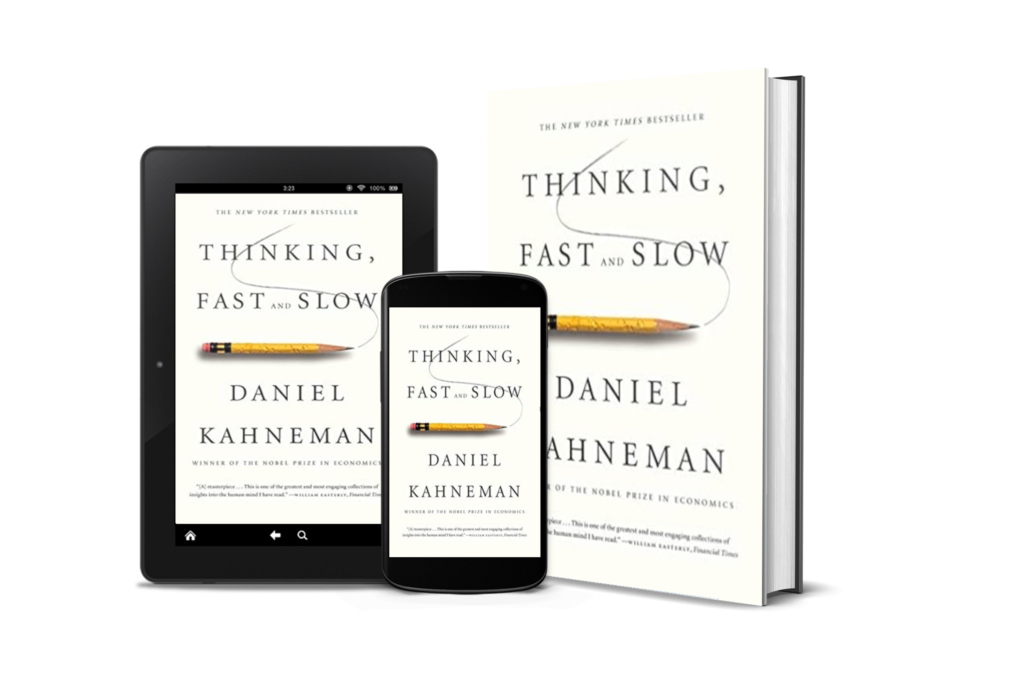
The “Thinking, Fast and Slow” 10 Key Lessons, Summary, Main Idea, and Story, About the Author: Daniel Kahneman, Key Takeaways, Video, Pros and Cons, and FAQs
4.6 ⭐⭐⭐⭐⭐ out of 5 stars (47,301)
See why 47,301+ readers love this book
Introduction
If you’re going to read it, here’s what you’ll get out of it:
Straight Answers: I’ve included clear answers to all the questions I had when I first picked it up.
Trust me, after reading this, you’ll start to see the hidden architecture of your own thoughts. You’ll never be able to unsee it. See it.
The Main Idea: The core argument that our thinking is governed by two systems—an intuitive, automatic “System 1” and a deliberate, analytical “System 2″—and that System 1’s shortcuts, while efficient, are riddled with systematic errors.
A Detailed Summary: A complete breakdown of the cognitive biases and heuristics that shape our judgments, often without our knowledge.
The Real Story: It shows you how to recognize the mental traps you fall into every day, giving you a fighting chance to make better decisions. (ready for both reading and video!)
Lessons for Today: The 10 big lessons are a toolkit for identifying and outsmarting your own flawed thinking. (For understanding how external factors influence your internal biases, read our review of Influence, New and Expanded Book.)
The Good & The Bad: I’ll give you my honest take on what makes the book a monumental achievement and where its academic depth can be challenging.
5 Root Causes of Bad Decisions: Apply this knowledge to become a more rational thinker in your work and life. (For principles on how psychology affects financial decisions, check out the Rich Dad Poor Dad Book.)
For a Strategic Perspective on Decision Outcomes (Extended Analysis):
Since understanding power dynamics involves strategic decision-making, find a different, extended analysis of this highly related book on our partner site:
The “Thinking, Fast and Slow” 10 Key Lessons, summary, and Main Idea
About the Author: Daniel Kahneman’s Key Takeaways, video, Pros and Cons, and FAQs
🎯 Main Idea and Summary: The Two Systems in Your Mind
Main Idea
The central idea of “Thinking, Fast and Slow” is that human thinking can be understood as the interaction between two cognitive systems. System 1 is fast, intuitive, automatic, and emotional. System 2 is slow, deliberate, analytical, and effortful. While we like to see ourselves as rational System 2 thinkers, most of our judgments and decisions are driven by the efficient but error-prone System 1, which relies on mental shortcuts (heuristics) that lead to predictable biases.
Summary
Daniel Kahneman takes readers on a tour of the mind, summarizing decades of his pioneering research with Amos Tversky. The book is structured in five parts, exploring the two systems, the heuristics of judgment, the overconfidence of our intuitions, the choices we make about risk, and finally, our two “selves” (the experiencing self and the remembering self). Each chapter introduces a specific cognitive bias—like anchoring, availability, loss aversion, or the halo effect—and illustrates it with compelling experiments and real-world examples. It’s a masterclass in why we make the mistakes we do, from trusting a confident presenter to misjudging future happiness.
Why You Fail The Simplest Test: Thinking, Fast and Slow Summary
Have you ever wondered why you sometimes make brilliant decisions, and other times you fall for the most obvious traps? Why do we often trust our gut feeling, even when the facts suggest otherwise? The answer lies in the silent, fascinating battle happening inside your mind, a battle between two distinct systems that control everything you do.
This revolutionary idea is the core of Daniel Kahneman’s masterpiece, Thinking, Fast and Slow. He argues that your brain has two main characters, which he calls System 1 and System 2.
System 1 is Fast, The Intuitive Mind. It’s instinctive, emotional, and automatic. It operates effortlessly and instantly. It’s what makes you instantly know the answer to $2+2$, recognize a familiar face, or immediately slam on the brakes in traffic. System 1 is a hero in saving cognitive time, but it’s a source of most of your biggest cognitive mistakes.
System 2 is Slow, The Rational Mind. This is your conscious, logical, and analytical self. It’s the part that is responsible for effortful mental activities. It’s what you use to solve complex algebra, compare mortgages, or meticulously fill out a tax form. It’s reliable, but it’s fundamentally lazy and tires out easily, often looking for shortcuts.
The central problem is that the confident and quick System 1 often jumps to powerful, biased conclusions and then passes them off to the lazy System 2, which generally endorses the conclusion without checking the work. This is where we get into trouble.
Let’s look at one major trap: the Availability Heuristic. Think about David, who is planning a vacation. He cancels his trip after seeing a sensationalized news report about a rare tropical disease. Statistically, the chance of him getting sick is near zero. But because the disease report was dramatic and easy to recall, his fast System 1 overestimates the risk. His slow System 2 is too tired or uninterested to check the actual health data, and the fear sticks. He ends up missing out on a great experience based on sensationalized media, not facts.
Another key bias is The Anchoring Effect. Imagine you are buying a used car. The seller first names an absurdly high price, say $40,000. They know you won’t pay it. But then they offer you a deal at $25,000. Suddenly, $25,000 feels like a bargain, even if the car’s true market value is only $18,000. The initial $40,000 price ‘anchored’ your slow thinking, creating a powerful, hidden influence on your final decision to pay too much.
And perhaps the most critical bias is Loss Aversion. Housel’s research shows we feel the pain of a financial or professional loss almost twice as powerfully as we feel the pleasure of an equal gain. This emotional bias often makes us cling to losing investments far too long, or makes us avoid necessary, calculated risks simply because the fear of loss is emotionally overwhelming.
Understanding these biases isn’t about becoming perfectly rational—that’s impossible. It’s about knowing when to slow down. The secret to making consistently smarter choices is learning to recognize the warning signs when your quick-thinking System 1 is about to make an expensive error, and consciously engaging your logical mind.
It’s about deploying your deliberate, analytical System 2 only when the stakes are high—when you are making a major investment, deciding on a career change, or setting a long-term strategy. The goal is to move from unconscious mistakes to conscious control.
Start today. Learn to listen to the whispers of your intuition, but always verify the critical facts with your logic. The difference between a good life and a great life often comes down to recognizing which system is truly running the show.
👨💻 About The Author: Daniel Kahneman
Daniel Kahneman is a Nobel Prize-winning psychologist and one of the founding figures of behavioral economics.
- Background: He is a Professor of Psychology and Public Affairs Emeritus at Princeton University. In 2002, he won the Nobel Prize in Economic Sciences for his work on prospect theory, integrating psychological insights into economics.
- Expertise: His career has been dedicated to understanding the mechanisms of human judgment and decision-making under uncertainty.
- Media Presence: While an academic, his work has had a profound influence on fields as diverse as medicine, finance, and public policy.
- Goal: With “Thinking, Fast and Slow,” Kahneman aimed to make his life’s work accessible to a general audience, providing a coherent and practical guide to the flaws and wonders of the human mind.
🔑 10 Key Lessons from “Thinking, Fast and Slow.”
The 10 key lessons reveal the most impactful and practical insights from Kahneman’s research.
| Phase | Key Lesson | Action/Insight |
|---|---|---|
| The Two Systems | 1. Meet System 1 and System 2 | System 1 runs automatically; System 2 allocates attention. Most of the time, lazy System 2 endorses the suggestions of System 1. |
| 2. Cognitive Ease is a Trap | If information feels familiar and easy to process (cognitive ease), System 1 is more likely to believe it’s true, regardless of its actual truth. | |
| 3. The Lazy Controller | System 2 is lazy and tires easily (ego depletion). When mentally tired, you fall back on System 1’s intuitive—and often flawed—judgments. | |
| Key Biases | 4. The Anchoring Effect | We are heavily influenced by arbitrary numbers we hear before making a decision. A starting point “anchors” our subsequent judgments. |
| 5. The Availability Heuristic | We judge the likelihood of an event by how easily examples come to mind (e.g., fearing plane crashes after seeing news of one). | |
| 6. Loss Aversion | Losses loom larger than gains. Losing $100 feels worse than winning $100 feels good. This shapes our decisions about risk. | |
| Decision Making | 7. The Halo Effect | If we see one positive trait in a person (e.g., they are attractive), we are likely to assume they have other positive traits (e.g., they are kind or competent). |
| 8. The Planning Fallacy | We are overly optimistic when predicting how long a task will take, ignoring past experiences and base rates. | |
| The Two Selves | 9. The Experiencing vs. Remembering Self | Your “Experiencing Self” lives in the present. Your “Remembering Self” tells the story of your life. They care about different things (e.g., duration vs. peak/end moments). |
| 10. Prospect Theory | People make decisions based on the potential value of losses and gains rather than the final outcome, and they evaluate these losses and gains using heuristics. |
💡 Key Takeaways from the Book
- Your Intuition is Flawed: Confidence is not a reliable indicator of accuracy. A story that feels coherent and easy to understand is often mistaken for a true one.
- You Can’t Trust Your Memory: Your “Remembering Self” constructs stories based on peaks and endings, not the total experience. This distorts your perception of past happiness and pain.
- Framing is Everything: The way a choice is presented (as a loss or a gain) dramatically affects your decision, even if the objective outcome is the same.
- Recognizing a Trap is the First Step to Avoiding It: While you can’t turn off System 1, you can learn to recognize situations where it’s likely to lead you astray and engage your System 2.
✅ Pros and ❌ Cons of “Thinking, Fast and Slow.”
| Feature | ✅ Pros (Advantages) | ❌ Cons (Disadvantages) |
|---|---|---|
| Narrative | Profoundly Insightful: This book fundamentally changes how you understand your own mind. It’s the foundational text for modern behavioral economics. | Dense and Academic: It is not a light read. The concepts are complex and require slow, thoughtful engagement to fully grasp. |
| Actionability | Provides a Diagnostic Toolkit: After reading, you have a vocabulary and a framework to diagnose why you or others made a poor decision. | Less a “How-To” Fix: It excels at diagnosing the problem but offers fewer prescriptive solutions for “fixing” your thinking. |
| Relevance | Universally Applicable: The biases affect everyone, from investors and managers to doctors and politicians. | Can Undermine Self-Trust: Learning about these biases can lead to excessive self-doubt or analysis paralysis. |
| Impact | Intellectually Transformative: It provides a new lens for viewing human behavior, making the world seem more predictable and understandable. | Some Replication Concerns: A small number of the studies cited have faced scrutiny in psychology’s “replication crisis,” though the core theories remain robust. |
💡 5 Root Causes of Bad Decisions (And Kahneman’s Diagnosis)
| Problem | The Common Trap | Kahneman’s Concept / The Diagnosis |
|---|---|---|
| P1: Relying on “What You See Is All There Is” (WYSIATI) | You make decisions based only on the information readily available, ignoring unknown unknowns and statistical base rates. | WYSIATI. System 1 constructs a coherent story from limited data. To counter it, actively seek out disconfirming evidence and base rate information. |
| P2: Misjudging Probability | You overestimate the likelihood of vivid, dramatic events (like terrorism) and underestimate common but boring risks (like heart disease). | The Availability Heuristic. Your judgment is based on how easily examples come to mind, not on statistics. |
| P3: Being Swayed by Irrelevant Numbers | A negotiator throws out a high initial number, and your entire counter-offer is unconsciously pulled toward that anchor. | The Anchoring Effect. You are influenced by random or irrelevant numbers. Generate your own anchor first, or be consciously dismissive of theirs. |
| P4: Fear of Loss | You hold onto a losing stock for too long because selling it would “make the loss real,” or you reject a good bet because you focus on the potential loss. | Loss Aversion. The pain of losing is psychologically about twice as powerful as the pleasure of gaining. Frame decisions in terms of overall wealth, not individual gains/losses. |
| P5: Overconfidence in Predictions | You confidently predict a project will be done in a week, ignoring all the past projects that took a month. | The Planning Fallacy & Overconfidence. Use reference class forecasting: base your predictions on the outcomes of similar cases, not on your optimistic internal scenario. |
👉 “If this post has touched your heart, imagine the impact the entire book could have on your life. Get your copy now.”
❓ Frequently Asked Questions (FAQs)
Can I actually use this to make better decisions?
Yes, but not by trying to “turn off” System 1. The power lies in “priming” your System 2. You can create decision-making checklists. Before a big decision, ask: “Am I falling for an anchoring effect?” “What are the base rates?” “How might loss aversion be warping my choice?” The goal is not to be perfectly rational, but to be less wrong.
What is the most surprising or useful bias?
For many, it’s Loss Aversion. Understanding that we feel losses about twice as intensely as gains explains so much behavior: why we hold onto bad investments, why we hate downsizing, and why free trials are so effective (because canceling feels like a loss). It’s a fundamental key to understanding human motivation.
How is this book different from “Nudge” or other behavioral economics books?
“Thinking, Fast and Slow” is the deep science and foundational theory. Books like “Nudge” by Thaler and Sunstein are the practical application. Kahneman explains the engine of the mind, while “Nudge” shows how to design the road (the “choice architecture”) to help that engine run better. Read Kahneman first to understand the “why,” then read “Nudge” for the “how.”
Is this book depressing? Does it mean we’re all irrational?
It’s not depressing; it’s liberating. It replaces the myth of human perfect rationality with a realistic and fascinating model of human nature. Understanding these flaws is the first step toward mitigating them. It’s not that we’re irrational, but that we are “predictably irrational.” That predictability is what gives us the power to improve.
People Also Ask
What are System 1 and System 2 thinking?
System 1 is fast, automatic, intuitive, and emotional. It answers 2+2, detects hostility in a voice, or drives a car on an empty road. System 2 is slow, deliberate, analytical, and effortful. It calculates 17×24, fills out a tax form, or monitors the behavior of a dangerous driver.
Who is the author of Thinking, Fast and Slow?
The author is Daniel Kahneman, an Israeli-American psychologist and Nobel Laureate in Economic Sciences. He is renowned for his work on the psychology of judgment and decision-making, which he conducted largely with his collaborator, Amos Tversky.
Final Verdict
‘Thinking, Fast and Slow’ is not just a psychology book; it is one of the most important and illuminating books ever written about the human mind. Kahneman’s work is a monumental achievement that provides the operating manual for your own brain. It is challenging, humbling, and utterly essential for anyone who wants to understand why they think what they think and do what they do.
Buy if you are ready for a deep, intellectually rigorous journey that will permanently alter your perception of yourself and everyone around you.
Rating: 4.6/5 stars— A challenging, masterpiece of psychology that is worth the effort.
Tags:
Thinking Fast and Slow
Daniel Kahneman
Cognitive Biases
Behavioral Economics
System 1 and System 2
Decision Making
Psychology
Nobel Prize
Judgment
Heuristics